Download
1 / 107
1.07k likes | 1.21k Vues
This comprehensive exploration delves into the enigmatic nature of dark energy, which comprises approximately 70% of the universe and drives its accelerated expansion. We discuss the classification of dark energy, including the cosmological constant and quintessence, and the implications of various energy densities (Ωb, Ωdm, and Ωh) in cosmology. Drawing from observations and theoretical frameworks, this work aims to unravel the complexities of the universe's composition, presenting insights into its gravitational interactions and the structure formation through primordial fluctuations.

E N D
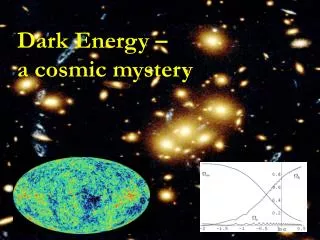
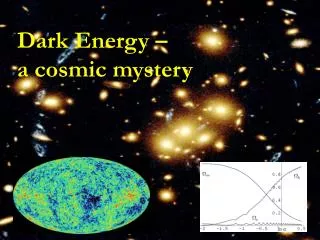
Dark Energy – a cosmic mystery
Quintessence C.Wetterich A.Hebecker, M.Doran, M.Lilley, J.Schwindt, C.Müller, G.Schäfer, E.Thommes, R.Caldwell, M.Bartelmann, K.Kharwan, G.Robbers, T.Dent, S.Steffen, L.Amendola, M.Baldi , N.Brouzakis , N.Tetradis, D.Mota, V.Pettorino, T.Krüger, M.Neubert
What is our universe made of ? fire , air, water, soil ! quintessence !
Dark Energy dominates the Universe Energy - density in the Universe = Matter + Dark Energy 1/4 + 3/4
Composition of the universe Ωb = 0.045 Ωdm= 0.225 Ωh = 0.73
critical density • ρc =3 H² M² critical energy density of the universe ( M : reduced Planck-mass , H : Hubble parameter ) • Ωb=ρb/ρc fraction in baryons energy density in baryons over critical energy density
Baryons/Atoms Dust Ωb=0.045 Only 5 percent of our Universe consist of known matter ! SDSS
Abell 2255 Cluster ~300 Mpc
Ωb=0.045 from nucleosynthesis, cosmic background radiation
Matter : Everything that clumps Abell 2255 Cluster ~300 Mpc
Dark Matter Ωm = 0.27 total “matter” Most matter is dark ! So far tested only through gravity Every local mass concentration gravitational potential Orbits and velocities of stars and galaxies measurement of gravitational potential and therefore of local matter distribution
Ωm= 0.27 gravitational lens , HST
Matter : Everything that clumps Ωm= 0.27 Abell 2255 Cluster ~300 Mpc
spatially flat universe Ωtot = 1 • theory (inflationary universe ) Ωtot =1.0000……….x • observation ( WMAP ) Ωtot =1.02 (0.02)
Mean values WMAP 2003 Ωtot =1.02 Ωm =0.27 Ωb =0.045 Ωdm =0.225
WMAP 2006 Polarization
Dark Energy Ωm + X = 1 Ωm : 1/4 Ωh : 3/4 Dark Energy h : homogenous , often ΩΛ instead of Ωh
Dark Energy density isthe same at every point of space “ homogeneous “ No force in absence of matter –“ In what direction should it draw ? “
Predictions for dark energy cosmologies The expansion of the Universe accelerates today !
dark energy and accelerated expansion second important property of dark energy: increase of Ωh causes accelerated expansion of the Universe change from deceleration to acceleration a few billion years ago
Structure formation : One primordial fluctuation spectrum CMB agrees with Galaxy distribution Lyman – α and Gravitational Lensing ! Waerbeke
Power spectrum Baryon - Peak galaxy – correlation – function M.Tegmark + … Structure formation : One primordial fluctuation- spectrum SDSS
Composition of the Universe Ωb = 0.045 visible clumping Ωdm= 0.22 invisibleclumping Ωh = 0.73 invisiblehomogeneous
Dark Energy – a cosmic mystery
What is Dark Energy ? Cosmological Constant or Quintessence ?
Cosmological Constant- Einstein - • Constant λ compatible with all symmetries • No time variation in contribution to energy density • Why so small ? λ/M4 = 10-120 • Why important just today ?
cosmological constant • poorly understood • naïve arguments on natural size based on estimate of quantum fluctuations often miss possible crucial symmetries or fixed point behavior • anthropic principle : a sophisticated way to say that we do not know – or a theory has no explanation …
Cosm. Const. | Quintessence static | dynamical
Energy density ρ ~ ( 2.4×10 -3 eV )- 4 Reduced Planck mass M=2.44×10 27 eV Newton’s constant GN=(8πM²) Cosmological mass scales Only ratios of mass scales are observable ! homogeneous dark energy: ρh/M4 = 6.5 10ˉ¹²¹ matter: ρm/M4= 3.5 10ˉ¹²¹
Time evolution tˉ² matter dominated universe tˉ3/2 radiation dominated universe • ρm/M4 ~ aˉ³ ~ • ρr/M4 ~ aˉ4~ t -2radiation dominated universe Huge age small ratio Same explanation for small dark energy?
Quintessence Dynamical dark energy , generated by scalarfield (cosmon) C.Wetterich,Nucl.Phys.B302(1988)668, 24.9.87 P.J.E.Peebles,B.Ratra,ApJ.Lett.325(1988)L17, 20.10.87
Prediction : homogeneous dark energyinfluences recent cosmology- of same order as dark matter - Original models do not fit the present observations …. modifications
Quintessence Cosmon – Field φ(x,y,z,t) similar to electric field , but no direction ( scalar field ) Homogeneous und isotropic Universe : φ(x,y,z,t)=φ(t) Potential und kinetic energy of the cosmon -field contribute to a dynamical and homogenous energy density of the Universe !
Cosmon • Scalar field changes its value even in the presentcosmological epoch • Potential und kinetic energy of cosmon contribute to the energy density of the Universe • Time - variable dark energy : ρh(t) decreases with time !
Evolution of cosmon field Field equations Potential V(φ) determines details of the model V(φ) =M4 exp( - αφ/M ) for increasing φ the potential decreases towards zero !
Cosmon • Tiny mass • mc ~ H (depends on time ! ) • New long - range interaction
“Fundamental” Interactions Strong, electromagnetic, weak interactions On astronomical length scales: graviton + cosmon gravitation cosmodynamics
cosmon : “the Higgs particle of dynamical dark energy” may be an effective or composite field , e.g. in certain modified gravity theories appears as quintessence field, chameleon, …and with many other names