Download
1 / 6
60 likes | 208 Vues
Lao PDR is undergoing a crucial transition from a planned economy to a market-based economy, beginning in 1986. Despite gradual reforms, the business and investment environment remains challenging. This document outlines the establishment of a Provincial Public Private Dialogue (PPPD) initiative aimed at improving economic governance and fostering collaboration between public and private sectors. Key objectives include better implementation of laws at the provincial level and creating feedback mechanisms for national law drafting. This approach seeks to promote sustainable private sector growth and address key economic bottlenecks.

E N D
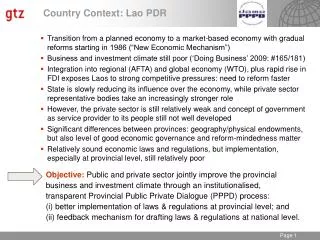
Country Context: Lao PDR • Transition from a planned economy to a market-based economy with gradual reforms starting in 1986 (“New Economic Mechanism”) • Business and investment climate still poor (‘Doing Business’ 2009: #165/181) • Integration into regional (AFTA) and global economy (WTO), plus rapid rise in FDI exposes Laos to strong competitive pressures: need to reform faster • State is slowly reducing its influence over the economy, while private sector representative bodies take an increasingly stronger role • However, the private sector is still relatively weak and concept of government as service provider to its people still not well developed • Significant differences between provinces: geography/physical endowments, but also level of good economic governance and reform-mindedness matter • Relatively sound economic laws and regulations, but implementation, especially at provincial level, still relatively poor Objective:Public and private sector jointly improve the provincial business and investment climate through an institutionalised, transparent Provincial Public Private Dialogue (PPPD) process: (i) better implementation of laws & regulations at provincial level; and (ii) feedback mechanism for drafting laws & regulations at national level.
Particularities of Lao PDR’s PPPD • Provincial-level PPPD and national level PPD (Lao Business Forum – LBF, supported by IFC/MPDF) coexist, roughly started at the same time • PPPD initiative forms part of wider GTZ Human Resource Development for a Market Economy Programme (HRDME), which seeks to tackle the key bottlenecks for sustainable private sector development in a concerted effort of public and private sector: • LNCCI: strategy development, incl. expansion of network and membership • MPI / DPI: investment promotion, streamlining, market economy principles • SMEPDO: SME strategy, action plan implementation and monitoring • Ministry of Education: integrated vocational education (public-private) • Strong, participatory, public-private co-leadership approach: • Central Taskforce on PPPD (LNCCI, MPI, SMEPDO, MoE) as key steering and support institution for the provincial dialogue • Additional support to private sector working groups via LNCCI • Drafting of guidelines, structures through consultative processes • Institutionalisation of PPPD • Blue-print for structure & processes, PPPD Guideline • Governor’s nomination of secretariat, approval of roles & responsibilities private public
GTZ-HRDME support terminates Roadshows to 2 additional provinces PPPD introduced to pilot provinces Central Taskforce on PPPD set up Roadshowsto 4 pilotprovinces Governor approval (CPS province) Central level secretariat full Lao ownership Link with LBF formalised PPPD guideline complete Fact-finding & consultation for structures & guideline Various PPPD meetings held in pilot provinces Reporting of PPPD generated issues at LBF Additional provinces join (?) Various PPPD Trainings & Coaching Mid 2007 Late 2005 Late 2008 Early 2009 2010(?) End 2010 Mid 2011 The PPPD Timeline & Key Milestones • Introducing PPPD idea • Familiarisation with dialogue concept • Testing capacity & ownership • Building trust • Ensuring top-levelsupport Now Introduction Indicator: solve min. 10 issues Institutionalisation • Developing PPPD blue print: structures & processes • Approval by governors / • PPPD brand-building • Quick wins • Establish secretariats / • Strengthen working groups • Link with LBF Full Ownership & Roll-out • Lao ownership of central-level secretariat & support structures • Further strengthening of ‘model’ provinces • Expansion to other provinces / Legend: () completed, () ongoing, () not yet started
national level as facilitator (support via stakeholders) provincial level PPPD Structure, Processes, and Support
Major Results & Lessons Learned Major Results: • Strong central-level support for PPPD initiative, both by public and private, based on increased mutual trust and understanding of benefits of PPPD • Request for expansion to two additional provinces by themselves and demand for nationwide expansion by MPI: evidence of ownership • PPPD guideline disseminated: strong ownership of drafting process • Development of blue-print for structure & processes: highly participatory • Trust-building between public and private sector through joint-activities, incl. planning, budgeting, implementation • Comprehensive PPPD branding/marketing strategy: high name recognition and support for PPPD initiative • Request by MPI permanent secretary for set-up of private sector consultation website in connection with economic crisis Lessons Learned: • Despite importance of an overall blue print for PPPD, flexibility for different preferences proved important to get initial support • Political support by provincial authorities (governor) crucial • Sound problem analysis and action planning of private sector crucial • Locally recruited external support important, especially at provincial level • Pushy approach not fruitful in Lao context, a gradual approach with strong emphasis on mutual trust and cooperation yielded better results
Challenges & Next Steps Challenges: • Lao ownership of central level secretariat • Linkage of national-level PPD (LBF) and provincial level PPPD • Degree of self-organisation of private sector working groups and capacity of support structure of chamber of commerce (albeit improving) • Quality of issue papers by private sector • Sustainable financial support • Differing levels of reform-mindedness of public sector by province Next Steps: • Linkage with LBF • Presentation of national level issues at LBF through formalised link • 10 issues solved by year end • Newsletter & website • Interprovincial forum on PPPD, possibly with participants from other countries • Increased support for PPPD ‘model’ provinces • Continued expansion to other provinces, depending on demand • Set up M&E system in line with Donor Committee for Enterprise Development (DCED) impact standards • Exit strategy (2011)