Download
1 / 10
100 likes | 200 Vues
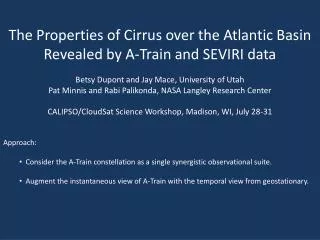
This study explores the properties of cirrus clouds over the Atlantic Ocean, leveraging data from the A-Train satellite constellation and the SEVIRI geostationary satellite. By combining instantaneous observations with temporal context, we analyze 100 cirrus events from 2007, categorized into anvil cirrus, high thin cirrus, and thick cirrus. The investigation focuses on the relationships between cirrus cloud properties and large-scale dynamics, examining case studies of thinning aging anvil clouds. Our work aims to enhance understanding of microphysical processes regulating cloud evolution and interactions with meteorological factors.

E N D
The Properties of Cirrus over the Atlantic Basin Revealed by A-Train and SEVIRI data Betsy Dupont and Jay Mace, University of Utah Pat Minnis and Rabi Palikonda, NASA Langley Research Center CALIPSO/CloudSat Science Workshop, Madison, WI, July 28-31 Approach: Consider the A-Train constellation as a single synergistic observational suite. Augment the instantaneous view of A-Train with the temporal view from geostationary.
The Global Coverage of High (>6km) Layers From Merged CC Data (RL-GEOPROF) Mace et al. (2008)
Clustering of Cirrus Events • 100-profile Atlantic cirrus events from 2007 • followed approach of Zhang (2007) • Clustering based on histograms of reflectivity and pressure Lidar Radar
P-dBZ Pattern for Resulting Cirrus Cluster Centroids • Anvil Cirrus • 13% of events • High, Thin cirrus • 60% of events • Thick Cirrus • 27% of events
Question: • What are the relationships between cirrus properties (and their temporal change) and the large-scale dynamics? • Next: • Track Cirrus in time following Soden (1998) technique • Case study of a dissipating aging anvil • Examine composite large-scale dynamics derived from NCEP/NCAR reanalysis for thickening and thinning cirrus in the northern and southern hemispheres
Case Study: A region of thinning AGING anvil cirrus R = 0.61 Bias = 91 g/m^2
Composite of Large-Scale Dynamics for Mid Latitude Thick Cirrus Tb decreasing (thickening) Tb increasing (thinning) • Northern Hemisphere • Southern Hemisphere * * * * ✪
Vertical Structure of Cirrus Layer Microphysics Thickening = red Thinning = black High, Thin Cirrus Thick Cirrus
Summary: Combining A-Train with Geostationary time series allows us to place events within a temporal context adding knowledge of changes in the hydrometeor field. Compositing of large-scale dynamics suggests strong relationships between temporal changes in the cloud field and meteorology. Work in Progress: Clustering cirrus based on large-scale dynamics What are the microphysical processes that control the differences in thickening and thinning cases? How do tropical anvils evolve from injected ice into long-lasting cloud fields?