
Acids and Bases
E N D
Presentation Transcript
Acids and Bases And neutralization reactions
Acids and Bases • An acid is a substance that produces hydrogen ions in solution. HCl H+ + Cl- • A base is a substance that produces hydroxide ions in solution. NaOH Na+ + OH-
Acids • Substances that releasehydrogen ions (H+) when mixed in water • Physical Properties: • Sour tasting • Wetto the touch when in solution • Water soluble • Good conductors of electricity, therefore electrolytes
Acids • Chemical Properties • React with metals to produce hydrogen gas • Corrosive • Make chemical indicators change colour • React with bases to produce a neutral solution
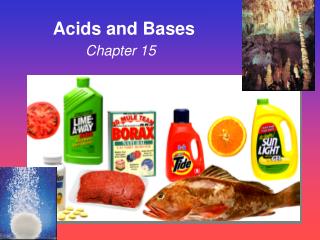
Acids • Examples:
Bases • Substances that release hydroxide ions (OH-) when mixed in water. Also called alkaline • Physical Properties: • Bitter tasting • Slippery to the touch when in solution • Water soluble • Good conductors of electricity, therefore electrolytes
Bases • Chemical Properties • Corrosive • Make chemical indicators change colour • React with acids to produce a neutral solution
Bases • Examples:
Chemical Indicators • Are solutions that change colour in acids and in bases • Can be either • natural or • synthetic
Chemical Indicators • Litmus paper: • Base turns it Blue! • Acid turns it Red! Universal Indicator is a mixture of chemicals that changes colour through a wide range of pH values
The pH scale • A numerical scale used to show how acidic or basic a solution is • pH stands for “power of hydrogen”
The pH scale • pH is a logarithmic scale which means that every unit on the scale represents a tenfold (10X) effect on the concentration of the solution
The pH scale: Logarithmic • This means that pH 3 is 10 times more acidic than ph 4. • If the value changes by more than one number you must multiply • ex. From pH 5 to pH 8 = 10 x 10 x 10 (3 steps = 10 multiplied by itself 3 times)
Naming Acids • A binary acid forms when an H+ bonds with a non-metal • HF (aq), HCl (aq), HBr (aq), HI (aq), H2S (aq), and H3P (aq) are some common binary acids • To name them, use the following structure: • “hydro + ______ ic acid”
Naming Acids • An oxyacid has a non-metal and an oxygen component • H3PO4, HClO3, HIO3, H2SO4, HBrO3, H2CO3, and HNO3 are some common oxyacids • To name them: • “_____________ ic acid”
Naming Bases • Name the metal • Name the polyatomic (i.e. hydroxide) • Example • Mg(OH)2 • magnesium hydroxide
Neutralization Reactions • A type of double displacement reaction • Acid + Base Water + Salt • A salt is an ionic compound. The pH of the products is around 7 (neutral) Example hydrochloric acid + sodium hydroxide water + sodium chloride
Practise!! • Try the practise questions on your worksheet!
Naming Acids and Their Ions • There are two main kinds of acids: binary acids and oxoacids. • A binary acid is composed of two elements: hydrogen and a non metal. The general formula for a binary acid is HX, where X is the non-metal. (HBr and HCl are two examples).
To name a binary acid • Attach the prefix hydro • Use the non-metal name as the root • Attach the suffic “ic” • Add the word acid
HF • Hydrofluric acid • HCl • Hydrochloric acid • HBr • Hydrobromic acid • HI • Hydroiodic acid • H2S • Hydrosulfuric acid
An oxoacid (oxyacid) is an acid formed from a polyatomic ion that contains oxygen, hydrogen, and another element. • For anions that end in “ate”, change the ending to “ic” and add the word acid • ClO3- is chlorate • HClO3- is called chloric acid
For anions that end in “ite”, change the ending to “ous” and add the word acid. • ClO2- is chlorite • HClO2- is chlorous acid
The prefixes hypo and per remain as part of the acid name. • ClO4- is perchlorate • HClO4- is perchloric acid