
SlideServe
Menu
Préférences
© SlideServe · v2026

Adaptive Systems

asis avatar
25 diapositives · 625 Views · Sep 29, 2012

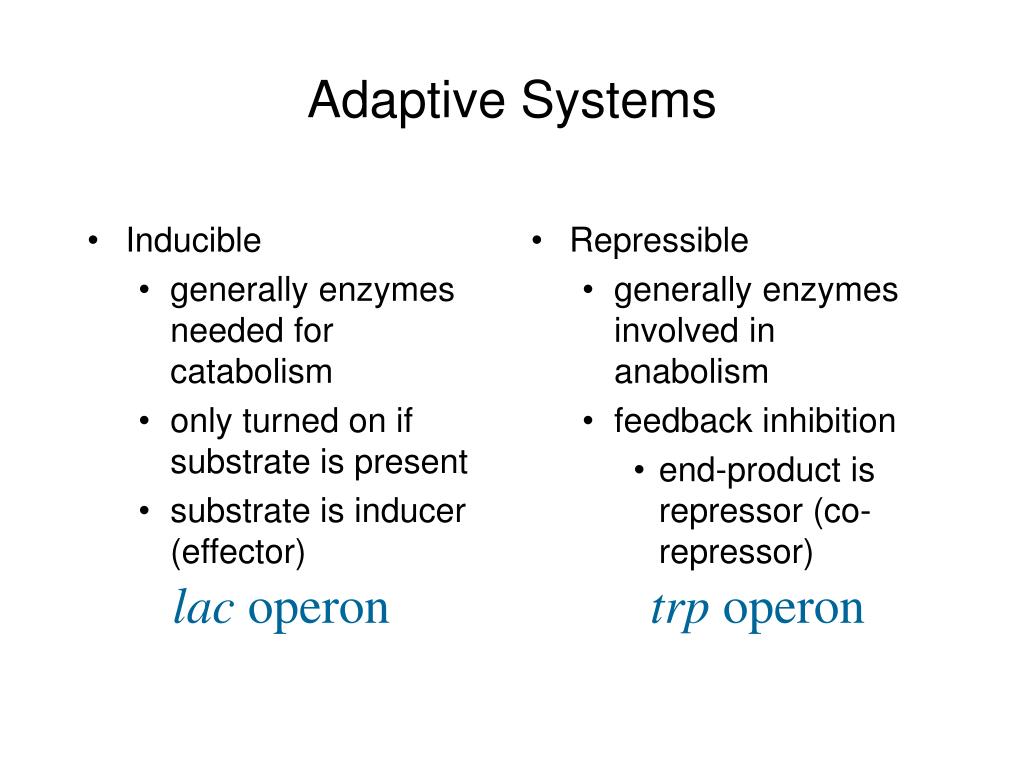
Inducible generally enzymes needed for catabolism only turned on if substrate is present substrate is inducer (effector). Repressible generally enzymes involved in anabolism feedback inhibition end-product is repressor (co-repressor). Adaptive Systems. lac operon. trp operon.
Adaptive Systems - slide 1
01 / 25Adaptive Systems
1 / 17

Télécharger la présentation

Adaptive Systems
Une image / un lien ci-dessous est fourni (tel quel) pour télécharger la présentation

Politique de téléchargement : le contenu du site vous est fourni TEL QUEL pour votre information et votre usage personnel ; il ne peut être vendu, concédé sous licence ni partagé sur d’autres sites sans l’accord de son auteur.Le contenu vous est fourni TEL QUEL, pour votre information et votre usage personnel uniquement. Téléchargez la présentation en cliquant sur ce lien. Lors du téléchargement, si vous ne parvenez pas à télécharger une présentation, l’éditeur a peut-être supprimé le fichier de son serveur.Pendant le téléchargement, si vous ne parvenez pas à obtenir une présentation, le fichier a peut-être été supprimé par l’éditeur.

F I N

Plus de contenu associé

Transcription de la présentation
  1. Inducible generally enzymes needed for catabolism only turned on if substrate is present substrate is inducer (effector) Repressible generally enzymes involved in anabolism feedback inhibition end-product is repressor (co-repressor) Adaptive Systems lac operon trp operon

  2. lac operon • Jacob and Monod • system of 3 structural genes plus regulatory genes • gene products digest lactose • only needed if lactose is present • polycistronic genes

  3. lac operon i p o z y a i = inhibitor gene; produces inhibitor protein p = promoter o = operator gene; allows binding of inhibitor protein z = beta-galactosidase y = permease a = trans-acetylase

  4. lac operon; off i p o z y a RNA polymerase blocked by protein on operator. Transcription stops.

  5. lac operon; induction i p o z y a = lactose lactose binds to the inhibitor protein causing an allosteric change

  6. lac operon; induction i p o z y a Lactose/inhibitor release from operator

  7. lac operon; induction i p o z y a z, y, and a genes are transcribed. lactose-digesting enzymes produced

  8. lac operon; induction i p o z y a As enzymes digest lactose, inhibitor protein is released. Inhibitor binds again to operator TRANSCRIPTION STOPS

  9. Catabolite repression of lac operon • Second level of control • Prevents full transcription of genes unless necessary • glucose preferentially digested • glucose/cyclic AMP levels regulate efficiency of lac promoter

  10. Catabolite repression of lac operon • Glucose a better energy source than lactose • In presence of both glucose and lactose, lac operon on at VERY LOW LEVELS • In absence of glucose, presence of lactose, lac operon fully expressed

  11. Catabolite repression of lac operon • Digestion of glucose converts cAMP to ATP • high glucose = low cAMP • low glucose = high cAMP • cAMP can bind to catabolite activator protein (CAP) • cAMP/CAP complex binds to promoter • increases efficiency of promoter

  12. Catabolite repression of lac operon i p o z y a cAMPATP Glucose CAP

  13. Catabolite repression of lac operon i p o z y a cAMPATP low glucose levels CAP

  14. Catabolite repression of lac operon • cAMP/CAP complex increases efficiency of promoter • Allows transcription at full speed if no glucose present • No cAMP, promoter remains “weak” = low transcription if glucose present

  15. trp operon • Repressible system • 5 polycistronic structural genes plus regulatory genes • Gene products synthesize tryptophan • needed unless tryptophan is available in the environment

  16. trp operon r p o t1 -- t5 r = repressor gene; produces aporepressor protein p = promoter o = operator t1 - t5 = five “tryptophan synthetase” genes

  17. trp operon; tryptophan needed r p o t1 -- t5 RNA polymerase binds; transcription takes place; enzymes produced Aporepressor alone cannot bind to operator

  18. trp operon; repression r p o t1 -- t5 tryptophan

  19. trp operon; repression r p o t1 -- t5 tryptophan binds to aporepressor complex binds to operator; stops transcription

  20. Attenuation of trp operon • second level of regulation to insure genes NOT transcribed if tryptophan is present • 5 trp structural genes very expensive energetically to transcribe/translate • tryptophan synthesis expensive energetically

  21. Attenuation of trp operon • Special sequences in DNA of leader region • leader/attenuator region • pair of inverted repeats • alternate binding possibilities

  22. Attenuation of trp operon r p o t1 -- t5 leader/attenuator region

  23. Attenuation of trp operon 1 2 3 4 RNA transcribed from 1and 2 may form stem-loop RNA transcribed from 3and 4 may form stem-loop RNA transcribed from 2 and 3 may form stem-loop

  24. Attenuation of trp operon -- OR --

  25. Attenuation of trp operon UUUUUU Transcription terminator signal