SlideServe
Menu
Préférences
© SlideServe · v2026

Complex Adaptive Systems

cybele avatar
12 diapositives · 1.1K Views · Jul 29, 2014

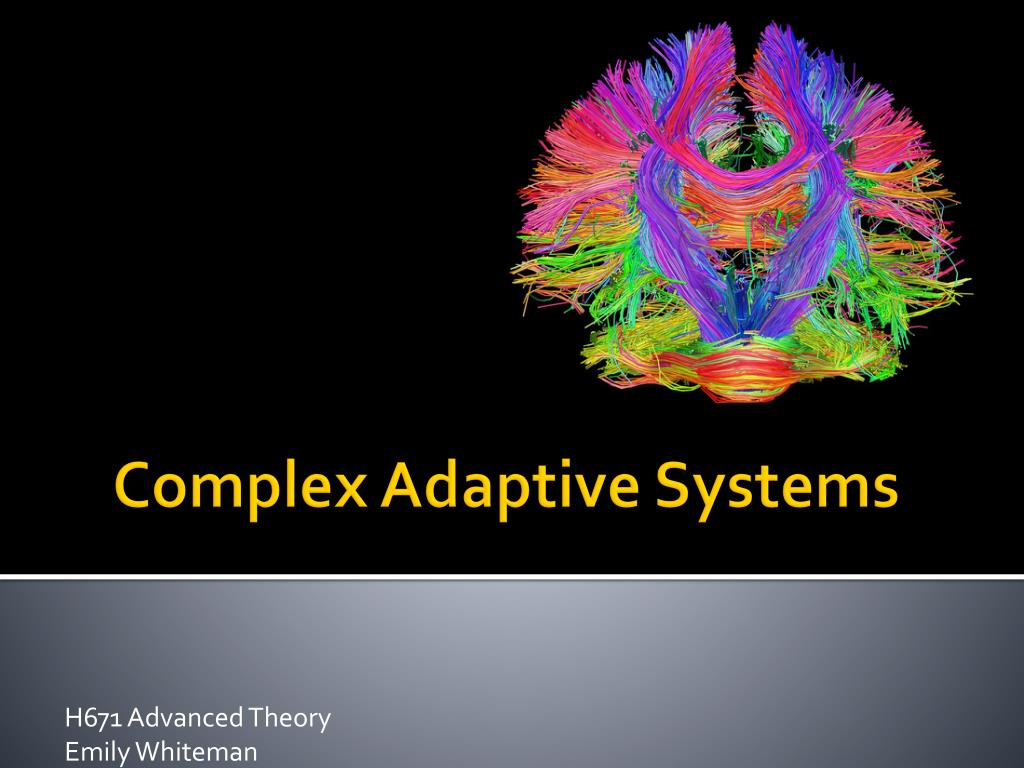
H671 Advanced Theory Emily Whiteman. Complex Adaptive Systems. What are Complex Adaptive Systems?. “Complex adaptive systems (CASs) consist of a set of interacting elements that are able to change and adapt in multiple ways” Zimmerman, Lindberg, & Plsek , 1998. Examples of CASs.
Complex Adaptive Systems - slide 1
01 / 12Complex Adaptive Systems
1 / 17

Télécharger la présentation

Complex Adaptive Systems
Une image / un lien ci-dessous est fourni (tel quel) pour télécharger la présentation

Politique de téléchargement : le contenu du site vous est fourni TEL QUEL pour votre information et votre usage personnel ; il ne peut être vendu, concédé sous licence ni partagé sur d’autres sites sans l’accord de son auteur.Le contenu vous est fourni TEL QUEL, pour votre information et votre usage personnel uniquement. Téléchargez la présentation en cliquant sur ce lien. Lors du téléchargement, si vous ne parvenez pas à télécharger une présentation, l’éditeur a peut-être supprimé le fichier de son serveur.Pendant le téléchargement, si vous ne parvenez pas à obtenir une présentation, le fichier a peut-être été supprimé par l’éditeur.

F I N

Plus de contenu associé

Transcription de la présentation
  1. H671 Advanced Theory Emily Whiteman Complex Adaptive Systems

  2. What are Complex Adaptive Systems? “Complex adaptive systems (CASs) consist of a set of interacting elements that are able to change and adapt in multiple ways” • Zimmerman, Lindberg, & Plsek, 1998

  3. Examples of CASs • Weather systems • Ecosystems • Neural connections in the brain • Human relationships • Communities

  4. Limitations of Linear Theories “Strive to produce a single, one-faceted, and static explanation of human behavior.” Do not account for: • Dynamic changes or adaptations occurring within a system. • Interactions among elements of the system. • Interaction among various systems. (Goodson, 2010)

  5. Tenets of Complex Adaptive Systems 1) Whole is much more than the sum of its parts. 2) CASs consist of other CASs: Each individual agent in a CAS is itself a CAS. 3) The agents in a CAS evolve with the CAS to which they belong 4) Diversity is necessary for the sustainability of a CAS. A decrease in diversity reduces the potential for future adaptations; diversity is key to innovation and long term viability of a CAS 5) CASs exhibit distributed control rather than centralized control (i.e., control is distributed throughout the system vs. a “command center”). Outcomes emerge from a process of self-organization rather than being designed and controlled externally.

  6. Tenets of Complex Adaptive Systems cont. 6) CASs are nonlinear systems: The size of the outcome may not be correlated to the size of the input. 7) CASs exhibit sensitive dependence to initial conditions (also known as “the butterfly effect”); they are history dependent. 8) CASs are naturally drawn to attractors. The attractor is a pattern or area that draws the energy of the system to it. 9) CASs manifest unpredictable behavior. 10) In a CAS, order underlies even what appears to be disordered or chaotic.

  7. Data Analysis Non-linear analysis: Realizes that the association may be better fit with a curved line (quadratic equation) Accounts for complexity and multiple interactions More mathematically complex Linear analysis: • An increase in X= an equal increase in Y • A decrease in X= an equal decrease in Y • Preferred, easy applicable, intuitive answers

  8. Gatrell, 2005 Complexity Theory & Health Geography

  9. Justification for Complexity Theory “ If one lesson has emerged from the spectacular failure of Western medicine to eradicate certain diseases, it is that diseases cannot be reduced to a single cause or explained within a prevailing linear scientific method: complexity is their hallmark.” (Harvard Working Group on New and Resurgent Diseases, 1996)

  10. Four Key Concepts Of CT • Relations and networks • Non-linearity • Emergence • Hybrids

  11. Discussion • What are some examples of properties that emerge at a collective level, that do not exist or are lessened when reduced to the individual level? • What is meant by “mutually reinforcing nexus”? Examples?

  12. Implications for Public Health Utilization of both linear and non-linear theories in design and data analysis provides the strongest approach for prevention. Complexity theories require the inclusion of other disciplines to fully understand behavior: • Law enforcement • Elected officials • Teachers • Civil engineers Increased collaboration between social and natural sciences