Download
1 / 18
180 likes | 302 Vues
This document outlines essential midterm policies, including logistics for taking the exam and guidelines on calculator use. Key aspects of enzymes are covered, highlighting their role as biological catalysts, properties, and mechanisms of action. The document also discusses enzyme kinetics, the glycolytic pathway, and regulation. Important metabolic pathways, thermodynamics, and the relationship between glycolysis and gluconeogenesis are explored. This comprehensive overview serves as a vital resource for understanding the biochemical reactions and their regulatory mechanisms.

E N D
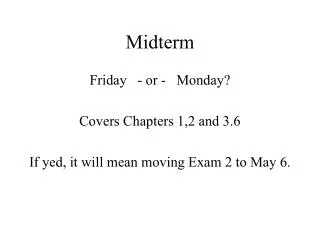
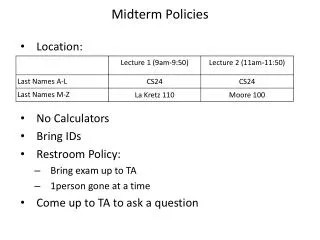
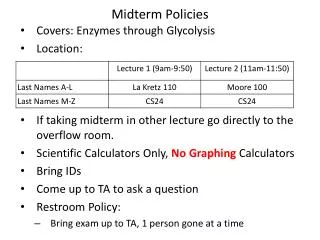
Midterm Policies • Covers: Enzymes through Glycolysis • Location: • If taking midterm in other lecture go directly to the overflow room. • Scientific Calculators Only, No Graphing Calculators • Bring IDs • Come up to TA to ask a question • Restroom Policy: • Bring exam up to TA, 1 person gone at a time
Office Hour Changes: • This week ONLY • Tuesday 12-2p (Young 4077A) • Canceled: Fri 10-11am • Additional: Thurs 4-6pm • Room: Boelter 5440
Properties of Enzymes • Biological Catalysts • Thermodynamically favorable reactions • Kinetically unfavorable reactions • Higher reaction rates (catalytic power) • Milder reaction conditions • Greater reaction specificity • Capacity for regulation
Properties of Enzymes • Active sites • Stabilize transition states • Geometric and Chemical Complementarity • Probe using good substrates, or good inhibitors; and direct modification or mutation • Cofactors • Metal Ions • Cosubstrates • Prosthetic groups
Catalytic mechanisms • Proximity and orientation effects • Acid-base catalysis • His, Ser, Cys, Tyr, Lys, Arg, Glu, Asp • Covalent catalysis • His, Asp, Cys, Ser, Lys • Metal ion catalysis • Preferential binding (stabilization) of the transition state
Serine proteases • Substrate binding pocket • Catalytic triad: • Serine • Histidine • Aspartate • Preferential binding of the transition state
Enzyme kinetics • Michaelis-menton Kinetics • Saturation kinetics • Assumption/Set up • Initial velocity; Catalysis is rate limiting • Steady state • [S]>>>>>>[E] [S]>>>>>>>[ES] • [Etotal] = [Efree] + [ES] • Vmax; KM; KCAT; Efficiency
Enzyme regulation • Amount • Inducible vs Repressible • Transcriptional Repressors vs Activators • Activity • Covalent (phosphorylation) • Non-covalent (allosteric regulators) • Rationale • Biological Efficiency, and flexibility • Competing reactions
Metabolic pathways • Thermodynamics • Standard: Go’ = -RTln[Keq] • In Cell : G= Go’ + RTln[Products/Reactants] • Opposing Pathways • Both thermodynamically favorable • Potential Futile cycle • Most steps reversible • Rate limiting step(s) irreversible and regulated
Metabolic pathways • Elucidation • Accumulation of intermediates • Labeling of intermediates • Enzyme regulation, amount vs activity
Glycolysis • Stage I : Preperatory phase (energy input) • Stage II: Payoff Phase (energy production) Glucose + 2 NAD+ + 2 ADP + 2 Pi 2 Pyruvate + 2 NADH + 2 H+ + 2 ATP
Glycolysis • Most reactions • Near Equilibrium, readily reversible • Glycolysis and gluconeogenesis • Driven by coupling to favorable reaction or removal of products • Other reactions • Far from equilibrium (highly favorable) • Irreversible • Only glycolysis • Regulated
Glycolysis: Each step • Rationale • Thermodynamics • Regulation?
Anaerobic fates of NADH • Regeneration of NAD+ for glycolysis • Homolactic fermentation • In muscle cells undergoing vigorous exercise • Lactate dehydrogenase • Alcoholic fermentation • In yeast (making beer) • Pyruvate decarboxylase and alcohol dehydrogenase
Gluconeogenesis • Pyruvate Glucose • When there is no other source of glucose • Potential futile cycle with glycolysis • Regulated by same effector as glycolysis but in opposite manner. • Fructose-2,6-bisphosphate
Fructose-2,6-bisphosphate Glycolysis (PFK) Gluconeogenesis (FbPase)