Optimizing Fat Metabolism in Exercise: Key Pathways and Limiting Factors
550 likes | 646 Vues
Learn about fat metabolism during exercise, including lipolysis, FA transport, and oxidation. Discover how hormones and intensity affect fat utilization. Explore the role of lipoproteins and intramuscular TG, and the mechanisms that limit fat oxidation. This comprehensive guide provides insights into maximizing fat energy utilization during physical activity.


Optimizing Fat Metabolism in Exercise: Key Pathways and Limiting Factors
E N D
Presentation Transcript
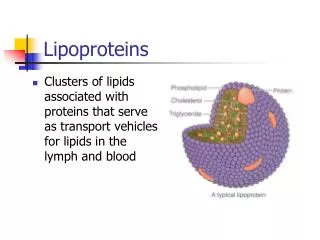
Ex Nutr c7-fat Lipoproteins 脂蛋白
Ex Nutr c7-fat Fat Metabolism during Exercise • Adipose Tissue - Triacylglycerol • Fatty Acid + Glycerol circulation • Re-esterification 再酯化: FA not released into circulation, but used to form new TG within adipose tissue • Intramuscular Triacylglycerol (IMTG) • Hormone Sensitive Lipase (HSL) • Circulation Triacylglycerol • Via Lipoprotein Lipase
Ex Nutr c7-fat Fig 6.1 overview of fat metabolism
Ex Nutr c7-fat What Limits Fat Oxidation • Lipolysis in Adipocytes • Removal of FAs from fat cell • Transport of fat by the bloodstream • Transport of FAs into the muscle cell • Transport of FAs into the Mitochondria • Oxidation of FAs in the β-oxidation pathway and TCA cycle
Ex Nutr c7-fat Lipolysis in Adipocytes • HSL – inactive form and active form • Sympathetic nervous system • Epinephrine • Insulin • Fate of glycerol • bloodstream – Liver for gluconeogenesis • Not used in adipocytes, because glycerolkinase very low (glycerol glycerolphosphate glycolysis)
Ex Nutr c7-fat Lipolysis in adipocytes • Fate of fatty acid • Re-esterification: 70% at rest • FA-binding proteins (FABP), transport FA to cell membrane • Exercise:↓re-esterification, ↑lipolysis ↑ FA in blood • Lipolysis in excess of demand for FA at rest and during exercise • Glycerol-P for re-esterification in adipocytes from glycolysis pathway
Ex Nutr c7-fat Removal of FAs from fat cell and Transport of fat by the bloodstream • Blood flow to adipose tissue • Albumin concentration and available binding sites • A transporter of FAs • 3 site for FAs • Typical plasma concentration 0.7 mM (45 g/L) • Albumin bind to albumin-binding proteins in target tissue, facilitate FA release and uptake • Maximal FA concentration in blood – 2 mM • Free FA toxic • Protective mechanism: incorporated into VLDL in liver • Lipoprotein TG <3% energy during prolonged ex • LPL activity ↑after training, ↑fat oxidation
Ex Nutr c7-fat Transport of FAs into the muscle cell • Plasma membrane FA binding protein (FABPpm) • FA transporter – FAT/CD36 • Fatty acid translocase • Saturated at 1.5 mmol/l - FA • Muscle contraction – translocation FAT/CD36 • Cytoplasmic FA binding protein (FABPc)
Ex Nutr c7-fat Fig 7.4 transport of glucose and FA
Ex Nutr c7-fat Intramuscular Triacylglycerol • Lipid droplets, usually located adjacent to mitochondria • Important energy source during exercise • Located closer to Mitochondria in trained muscle • HSL • FA released bound to FABPc until transported into mitochondria
Ex Nutr c7-fat Fig 7.5 Electromyograph of skeletal muscle. Lipid droplet (li); mitochondria (mi); glycogen (gl)
Ex Nutr c7-fat Transport of FAs into Mitochondria • Acyl-CoA Synthetase • CPT I & CPT II Carnitine Palmitoyl Transferase I & II • Short- and Medium-Chain FAs diffuse freely into mitochondrial matrix • Fatty acyl-CoA in mitochondrial matrix is subjected to beta-oxidation • Acetyl-CoA for TCA cycle
Ex Nutr c7-fat Fig 7.6 Transport of FA into mitochondria
Ex Nutr c7-fat Fig 7.7 beta-oxidation
Ex Nutr c7-fat Fat As A Fuel During Exercise • At Rest • Lipolysis regulated by hormones • FA concentration 0.2-0.4 mM in blood • During moderate exercise • ↑Lipolysis ~3X, ↑ blood to adipose tissue 2X, ↓re-esterification 0.5X, ↑ blood flow to muscle • FA in blood decrease in the first 15 min: rate of uptake by muscle > rate of appearance by lipolysis • FA increase thereafter, may reach 1 mM • Higher intensity exercise • Rise in plasma FA very small or absent • Lactate ↑re-esterification in adipocyte, ↓FA release
Ex Nutr c7-fat Lactate ↑re-esterification in adipocyte,↓FA release
Ex Nutr c7-fat Fat Oxidation,Exercise Duration and intensity • ↑ Fat oxidation when exercise duration ↑ • Fat Oxidation rate at 1.0 g/min after 6 hr running • Fat oxidation rate can reach 1.5 g/min after high-fat meal • Low to moderate intensity – Fat dominated • >75%VO2max – Fat oxidation rate inhibited • Maximal fat oxidation rate usually 62-63% VO2max
Ex Nutr c7-fat Fig 7.8 Fat oxidation as function of exercise intensity
Ex Nutr c7-fat Fat Oxidation and Exercise Intensity • Infusion of TG (Intralipid) and heparin 肝素during higher intensity exercise ↑FA oxidation rate • But still lower than at moderate intensity • Even plasma FA concentration same as that at moderate intensity • During higher intensity exercise, oxidation of long-chain FA impaired, but oxidation of medium-chain FA unaffected • ↑glycolytic flux, ↑pyruvate and acetyl-CoA, inhibit CPT-1 • Carnitine-dependent FA transport may be limiting factor for FA oxidation during exercise • Medium-chain FA do not need transport system across mitochondria
Ex Nutr c7-fat Fig 7.9 substrate utilization at different exercise intensities
Ex Nutr c7-fat Fig 7.10 Lipid-heparin infusion significantly ↑plasma [FA] and fat oxidation rate at 85% VO2max. The fat oxidation rate with infusion is still lower than that in 65% VO2max (not shown), Fat infusion ↓CHO oxidation rate by ↓ muscle glycogen utilization (not shown)
Ex Nutr c7-fat Fat Oxidation and Aerobic Capacity • Endurance training↑fat oxidation contribute to total energy expenditure • ↑ Mitochondria density, ↑ Oxidative enzyme • ↑ Capillary density ↑FAs, oxygen to muscle • ↑ FABP • ↑ CPT • After training, rate of lipolysis at same absolute exercise intensity NOT affected • After training, rate of lipolysis at same relative exercise intensity NOT affected • ↑IMTG lipolysis contribute to ↑whole-body lipolysis
Ex Nutr c7-fat Fig 7.11 Whole-body lipolysis in trained and untrained subjects
Ex Nutr c7-fat Fat Oxidation and Diet • High CHO, low fat diet : ↓fat oxidation • High fat, low CHO diet: ↑fat oxidation • Fat oxidation still higher after 5 days of high-fat diet and then 1- day high-CHO diet • Compared to 6-day high-CHO diet • 1-day high-CHO diet replenish muscle glycogen, similar levels in both groups • Not due to substrate availability • Adaptations at muscular level may occur within 5 days • Chronic diet may affect metabolism
Ex Nutr c7-fat Response to Carbohydrate Feeding • Ingestion of CHO before exercise, ↑ Insulin secretion • ↑CHO oxidation, ↓Fat oxidation • FA availability only partially responsible • Glucose feeding 1 hr before exercise ↓plasma FA concentration and ↓ Fat oxidation • Infusion of Intralipid and heparin only partially restored fat oxidation • Study using labeled Long- and Medium-chain FA indicated carnitine-dependent FA transport into mitochondria also responsible
Ex Nutr c7-fat Regulation of CHO & Fat Metabolism • ↓Muscle glycogen breakdown with ↑plasma FA concentration • Infusion of intralipid • Fat feeding in combination with heparin infusion (↑lipoprotein lipase and hepatic lipase activities) • Problems in control group • FA concentration very low, <0.2 mM • ↑glycogen breakdown in control group, rather than observed glycogen-sparing effect in high-fat group
Ex Nutr c7-fat Regulation of CHO & Fat Metabolism –glucose- fatty acid cycle • ↑plasma FA, ↑FA uptake, ↑acetyl-CoA and citrate • ↑acetyl-CoA/CoA inhibit pyruvate dehydrogenase • ↓pyruvate acetyl-CoA • ↑citrate inhibit phosphofructokinase • After citrate diffuse into sarcoplasma • ↓glycolysis accumulation of glucose-6-P in sarcoplasma ↓hexokinase, ↓muscle glucose uptake • ↑FA availability ↑NADH ↓intramuscular Pi and AMP • Pi and AMP stimulate glycogen phosphorylase • ↑FA availability ↓muscle glycogen breakdown
Ex Nutr c7-fat Fig 6.14 Glucose-FA cycle, or Randle cycle
Ex Nutr c7-fat Regulation of CHO & Fat Metabolism –recent theory • Fat dose NOT regulate CHO metabolism • It is CHO that regulates fat metabolism • ↑glycolysis ↓fat oxidation • ↑acetyl-CoA in muscle during high-intensity ex • Some acetyl-CoA malonyl-CoA by acetyl-CoA carboxylase • CPT1 inhibition ↓FA transport to mitochondria • By ↑ Malonyl-CoA • Also by ↓ intramuscular pH during high-intensity ex • ↑acetyl-CoA bind to carnitine ↓free carnitine, ↓cartinine for FA transportation • Fat oxidation mainly influenced by fat availability and rate of CHO oxidation
Ex Nutr c7-fat Fig 6.15 Glucose FA cycle reversed
Ex Nutr c7-fat Fat Supplementation and Exercise • Ingestion of Long-Chain Triacylglyerols • Dietary LCFA TG in chylomicron • Breakdown of TG in chylomicron very low by muscle during exercise, should avoid fat intake • Replenishment of IMTG stores AFTER exercise • Some sports bars or energy bars contain high fat • Ingestion of Medium-Chain Triacylglyerols • C8 or C10, very low in natural foods, mainly used as supplements • Most studies showed no effect on performance • Large ingestion (> 15 g/h) may cause GI problems • Ingestion of Fish Oil • Omega-3 FAs • More omega-3 FAs incorporated into membrane, may improve membrane characteristics and function
Ex Nutr c7-fat Effects of Diet on Fat Metabolism and Exercise Performance • Fasting • ↑lipolysis, ↑plasma FA • ↓ endurance performance, even with CHO ingestion during exercise • Effects of Short-term high-fat diet • ↑lipolysis, ↑plasma FA ,↑Fat oxidation rate, ↑ Ketone bodies 酮體(5X after 5 days of high-fat diet) • ↓ endurance performance, ↓ muscle glycogen
Ex Nutr c7-fat Effects of long term high-fat diet (several weeks) on performance • 60-65% VO2max, may be impractical • Maintain time to exhaustion at 60-65% VO2max, despite muscle glycogen ↓by 50% • CPT↑ 44%, hexokinase ↓46% • Relatively low intensity, reduced CHO stores may not be limiting factor • 7 wk high-fat + 1 wk high-CHO vs 8 wk high-CHO • Time to exhaustion at 81% VO2max↑from wk7 to wk 8 • Still less than 8-wk high-CHO group • Suboptimal adaptation to training • High-fat diet • may only helpful in low-intensity exercise • Negative effect on general health • Not recommended for athletes
Ex Nutr c7-fat Fig 7.17 high-fat diets and performance during training in humans
Ex Nutr c7-fat Fat adaptation impair glycogenolysis • Most fat adaptation studies (days or weeks of high-fat diet) show no effect on endurance performance • Despite ↑fat oxidation, ↓CHO oxidation • High-fat diet ↑pyruvate dehydrogenase kinase, ↓pyruvate dehydrogenase • At rest, throughout 70% VO2max exercise, 1-min sprint • ‘glycogen sparing’ effect of high-fat diet actually impairment of glycogenolysis
Ex Nutr c7-fat Spriet LL, JSS 2004