Exploring Topic Maps: Enhancing Information Retrieval and Knowledge Management
This presentation by Peter-Paul Kruijsen, CTO of Morpheus Software, delves into the powerful concept of Topic Maps. It establishes the framework for organizing and retrieving knowledge in a more meaningful way than traditional search engines. Highlighting Morpheus’s expertise in knowledge engineering, the session explores key elements such as topics, associations, and occurrences. Attendees will learn how Topic Maps facilitate seamless knowledge management, enhance information sharing among colleagues, and provide advanced methods for representing complex knowledge domains.

Exploring Topic Maps: Enhancing Information Retrieval and Knowledge Management
E N D
Presentation Transcript
Topic Maps introduction Peter-Paul Kruijsen CTO, Morpheus software ISOC seminar, april 5th 2005
Introduction Morpheus • Morpheus is a software company based in Maastricht • Founded: 1999 • Focus: knowledge engineering and topic mapping • Employees: information- / knowledge experts • Partnership with Ontopia • Implementation partner • Value added reseller for OKS • Expertise in Topic Maps • Informing / Evangelism • Conceptual modelling • Implementation • Training http://mssm.nl
Scope • I want to • Search in a meaningful way (better than Google) • Find information without precisely knowing what I am looking for (spontaneous knowledge creation) • Share and retrieve information among colleagues • Use my own terminology and store personal knowledge • Then I need something that can • Clearly denote and identify concepts • Relate concepts in a meaningful way • Display all information about a concept in one overview • An answer to this is • Topic Maps and PSI’s http://mssm.nl
Topic Maps and PSI’s • With Topic Maps and PSI’s I can • Organize large sources of information • Capture and share common knowledge • Represent complex rules and processes • Present information in a subject based manner • Manage distributed knowledge and information • Aggregate information and knowledge • The result will be ‘Seamless knowledge’ http://mssm.nl
Topic Maps and indices • The rationale of Topic Maps can be compared to the contents and index of a book • Distinction between information (contents) en knowledge (index) • Index gives description and overview on domain • Contents give full detail • In Topic Maps, the ‘index’ is extended • Not only references to contents • Also includes associations to other concepts in index • Topic map represents a complete domain • Advanced way of adding metadata • Information is stored/accessed subject based http://mssm.nl
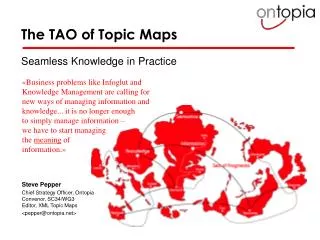
The TAO of Topic Maps • The TAO of Topic Maps describes the three main concepts within Topic Maps • Topics • Represent ‘subjects’ in the real world • Associations • Make connections between topics • Occurrences • Relate topics to information sources • http://www.ontopia.net/topicmaps/materials/tao.html http://mssm.nl
Netherlands Limburg Maastricht Morpheus Gabriel Hopmans Peter-Paul Kruijsen Father Grandfather The TAO in practice • Topics for people and organisations • ‘Person’ en ‘organisation’ are topics themselves • Typed associations • ‘Employment’ is also a topic • References to information sources http://mssm.nl
Ontology • By typing topics, associations and occurrences, we get • Meaningful information • A semantic network • Knowledge • Key subjects make up an ontology • Domain description within topic map itself • Can be used to model hierarchies • Thesauri / Classifications / Part-whole • Ontology types are topics themselves http://mssm.nl
Identification • Identification of concepts is essential to enable sharing of information • Name based identification is not good enough • Synonyms / homonyms • By identifying concepts we can attach multiple names and charachteristics • Multilingual naming / Various target groups • Medical expert versus patient • Identification by means of PSI’s • ‘http://psi.oasis-open.org/iso/639/#eng’ for ‘english’ • For computers: identification based on URL’s • For humans: indicators describing concepts http://mssm.nl
Querying • Because a topic map is highly structured, it can be queried by semantic queries • ‘Give me all names of grandfathers of directors of Limburgian companies’ • tolog provides predicate based query language • Official TMQL to be published as ISO standard • Queries are used in applications for navigation and presentation purposes • Inference rules to generate new information http://mssm.nl
Constraining • Allows to restrict the otherwise free and open topic map content • In Topic Maps you are allowed to state • ‘Pink floyd’ was recorded by ‘Dark side of the moon’ • ‘Peter-Paul’ is of type ‘Morpheus’ • The Topic Maps Constraint Language (TMCL) makes sure to avoid these mistakes by introducing constraints on topic map content • An ‘employer’ in an ‘employment’ association should always be an organisation • A person may have only one date of birth http://mssm.nl
Filtering • By using scope, data in a topic map can be filtered for specific goals • Multilingual interfacing • Contextualising information • Include source of information • Specific target groups • Personal settings • Scope is yet another set of topics • Scope on ‘french’, ‘expert term’, ‘gossip’ http://mssm.nl
Visualising • Tools are available for graphical presentation of a topic map • In a webapplication • Stand-alone • Offers overview • Topic Maps • RDF • Configurable • Color / Shapes • Branching http://mssm.nl
Merging • Topic maps can be merged automatically based on PSI’s • Seamless knowledge emerges by sharing concepts • Merging topic maps enables endless possibilities • Information integration between domains • Aggregating and sharing knowledge among organisations • Knowledge federation from various sources • Distributed knowledge management • Re-use of knowledge throughout various applications http://mssm.nl
Possible applications • Topic Maps and the five techniques we just saw can be applied in numerous ways • Intelligent indexes • Single point of access to information • Intuitive navigation • Dual / multiple classification • Concepts can be classified along multiple dimensions • Topic Maps driven web portals • Navigation and content are driven by Topic Maps • Application integration • ERP/CMS/... • E-Learning systems • Brainbank http://mssm.nl
Conclusion • Topic Maps make a good tool for • Intuitive overviews on information • Sharing knowledge • Integrating information and applications • Maintenance of existing systems • The possibilities are endless • For today: get inspired • For those interested: more info / training course • Morpheus would like to help you get started http://mssm.nl