Understanding Acids, Bases, and Titration: A Comprehensive Revision Exercise
80 likes | 231 Vues
This revision exercise covers the fundamental concepts of acids and bases including their definitions, properties, and examples such as lemon juice, hydrochloric acid (HCl), and sodium hydroxide (NaOH). It details the titration process used to accurately mix an acid with a base, along with the stages of preparing a sample of salt (NaCl) through neutralization. Additionally, the exercise discusses how the addition of acid lowers the solution's pH to 7, demonstrating the importance of such reactions in everyday applications.


Understanding Acids, Bases, and Titration: A Comprehensive Revision Exercise
E N D
Presentation Transcript
Acids and Bases - Titration 19/01/12
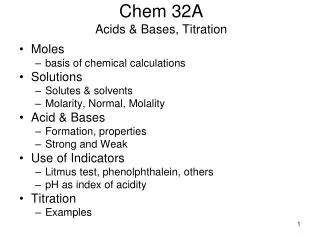
Revision exercise • Acid • An acid has a sour taste. • Lemon juice is an example of an acid. • An acid has a pH value between 0 and 7 • Base • Indicator • Litmus • pH
Stage 1 • Use the 10cm3 pipette and pipette filler to measure out 20cm3 of sodium hydroxide (NaOH) and put it in the conical flask • Make sure to match the bottom of the meniscus with the scale on the pipette.
Stage 2 - Titration • Titrations are used to very accurately add a certain amount of an acid to a base. • Fill the burette accurately with 50cm3 of Hydrochloric acid (HCl) • Remember to line up bottom of meniscus 3 1 2
Stage 3 - Evaporation • Place the resultant solution from the final titration into an evaporating dish • Put the dish on a gauze on a tripod • Heat the dish with a Bunsen burner until all the liquid is gone
To titrate hydrochloric acid (HCl) against sodium hydroxide (NaOH) and prepare a sample of salt NaCl • For our experiment we are using 1M HCl with a pH value of 0 • And 1M NaOH with a pH value of 14 • We add the HCl to the NaOH • What do you think will happen to the pH value of the resulting solution?
To titrate hydrochloric acid (HCl) against sodium hydroxide (NaOH) and prepare a sample of salt NaCl • Stage 1 • Stage 2 • Stage 3 3 1 2
Discussion of results • We have just performed a neutralisation reaction. The addition of the HCl lowered the pH of the solution to 7 • Neutralisation • ACID + BASE = SALT + WATER • HCl + NaOH = NaCl + H2O • Can you think where this type of reaction might be useful in everyday life?