Unveiling the Secrets of Stars: Color, Composition, and Movement through Spectral Analysis
90 likes | 291 Vues
Discover how astronomers decode the mysteries of stars using color and spectral analysis. By examining a star's color temperature, size, and age, we can glean insights into its nature. Each element, like hydrogen, helium, and carbon, has a unique spectral fingerprint when heated, allowing us to identify their composition in distant stars. Additionally, understanding red and blue shifts enables the determination of a star's movement and the mass of its orbiting planets by studying the cyclic Doppler shift. Join us on this cosmic journey to unravel the universe!


Unveiling the Secrets of Stars: Color, Composition, and Movement through Spectral Analysis
E N D
Presentation Transcript
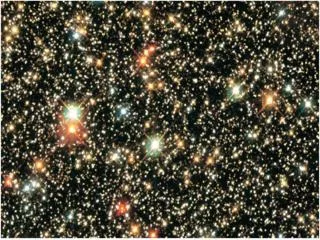
Stars and spectral analysis: WHAT THE COLORS CAN TELL US
HOW TO IDENTIFY THE COMPOSITION OF STARS • Hydrogen • Helium • Carbon • Iron When heated, each element emits its own unique and distinct pattern of wavelengths of light. This is known as a SPECTRAL FINGERPRINT. By using a database of these “fingerprints”, astronomers can identify the composition of a distant object. For example, the spectral pattern produced by a star is shown below. It matches the spectral fingerprint of Hydrogen – therefore, we now know that the star is composed of Hydrogen gas!
RED AND BLUE SHIFTS: How light is used to determine the movement of stars
How light is used to detect “invisible” alien planets BY OBSERVING STARS: By measuring the cyclical Doppler shift of a star, astronomers can figure out how far the star is wobbling, which allows them to figure out THE MASS OF ITS ORBITING PLANET, AND ITS DISTANCE FROM THE STAR