Download
1 / 17
170 likes | 305 Vues
Explore the life and artistic journey of Diego Rivera, a pivotal figure in 20th-century art. Born on December 13, 1886, in Mexico City, Rivera studied at the Academy of San Carlos, showing early influences from artists like Velasco. His venture into Cubism, inspired by his encounter with Pablo Picasso in Spain, transformed his style. This piece delves into Rivera's murals, especially the iconic work at the Rockefeller Center, and examines the intersection of art, business, and human services, shedding light on his legacy and the impact of the Industrial Revolution on modern art. ###

E N D
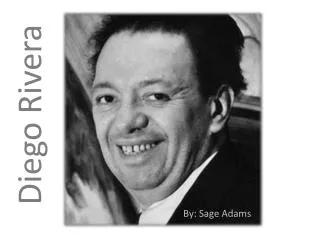
Diego Rivera Por Sofia y Matilde
La Vida • El 13 de diciembre, 1886 • 1892 -La Ciudad de México • Academia de San Carlos -1896
El Estilo • Influencia de Velasco • Las obras primeras-Paisajes • Una pintura:
Business, Mangagement, Marketing & Technology… • Possible Careers • Computer Info. System • Finance • Accounting • Sales & Marketing • Are you a leader? • Are you a planner? • Do you think you’d like to work in business? • Do you like things orderly?
How does this relate??? • Industrial Revolution of the 19th Century • Official Art • Vanguard Teams • New Avenues • Marketing of Work • Cubism-Picasso & Braque
Las Pinturas Cubistas • En España, 1914, Diego conoció a Pablo Picasso. • Diego pintó la Adoracion del Virgen y el Niño, su primera pintura cubista.
Pinturas Murales Ésta es la pintura mural por Rivera en el Rockefeller Center of Art en Nueva York.
What if My CP Were Human Services? • Are you friendly? • Are you cooperative? • Do you like tutoring young children? Maybe this Career Pathway is for you— • Government • Law • Leisure & Recreation • Education
How did Human Services Shape Diego Rivera & His Artwork? • Both parents teachers • Studied art before reading • Academy of San Carlos, México • Unhappy • José Posada-a true teacher
Trip to Europe-Human Services • Diego wanted to learn • Scholarship-Governor of Vera Cruz • Moved to Europe • Countryside artwork
Detroit Institute of Art Frente
Detroit Institute of Art Oeste
Bibliography • http://www.yale.edu/ynhti/curriculum/units/1999/2/99.02.06.x.html#a • http://www.diegorivera.com/index.html
Don’t forget!!! • A bibliography page-listing links, books, etc. • You have to LINK each of the works of art to your CP-also you must be able to talk style and meaning of the work • It is not enough to say, “this links to our CP” you need a CONCRETE example-such as—Cubism was developed originally to explore new options to better market artwork after the 19th century Industrial Revolution. • Please make sure to REVIEW the rubric to make sure you aren’t missing any parts-although we are editing your work, we will not be responsible for making sure you have all of the required elements—we are working with what is turned in