Understanding Biological Classification: A Journey Through Taxonomy and Evolution
This overview explores the classification of living organisms, emphasizing the importance of taxonomy in organizing biological diversity. It introduces the binomial nomenclature system, developed by Linnaeus, which categorizes organisms into hierarchical levels from species to kingdom. As scientific understanding evolves, so does classification, transitioning to a modern evolutionary perspective that focuses on phylogeny and molecular similarities. The current six-kingdom and three-domain systems reflect advancements in biological research, illustrating the dynamic nature of life and its classification.

Understanding Biological Classification: A Journey Through Taxonomy and Evolution
E N D
Presentation Transcript
Classification 18.1 Finding Order in Diversity
Why Classify? • To study the diversity of life, biologists use a classification system to name organisms and group them in a logical manner. • Taxonomy
Assigning Scientific Names • Common names can be confusing and vary between regions. • Scientists agreed to use Latin and Greek when assigning scientific names to organisms. • This practice is still followed today as new organisms are discovered.
Binomial Nomenclature • Two-word naming system used in differentiating a species • Genus species • A genus is a group of related species. • Ursusarctos • Ursusmaritimus
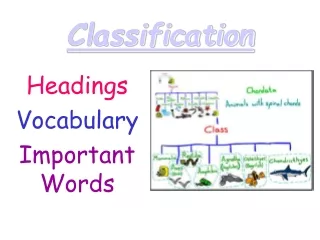
Linnaeus's System of Classification • Includes seven levels- from smallest to largest • Species, Genus, Family, Order, Class, Phylum, Kingdom • Each level is called a taxon.
Linnaeus's System of Classification • Family • Genera that share many characteristics • Ursidae • UrsidaeUrsusarctos • UrsidaeUrsusmaritimus • UrsidaeAiluropodamelanoleuca
Linnaeus's System of Classification • Order • Broad taxanomic category composed of similar families • Carnivora • Examples: • Canidae • Felidae • Ursidae
Linnaeus's System of Classification • Class • Composed of similar orders • Mammalia • Includes animals that are warm blooded, have body hair, and produce milk for their young.
Linnaeus's System of Classification • Phylum • Includes many different organisms that share important characteristics • Chordata • Mammalia • Aves • Reptilia • Amphibia • Several classes of fish
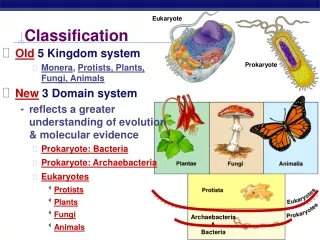
Linnaeus's System of Classification • Kingdom • Largest and most inclusive level • Linnaeus started with only 2- Animals & Plants • Now, we recognize 6! • Plants, Animals, Protists, Fungi, Archaebacteria, Eubacteria.
Classification 18.2 Modern Evolutionary Classification
Which Similarities Are Most Important? • Organisms determine who belongs in their species by choosing whom they mate with! • Scientists have “invented” larger taxa according to an organisms characteristics.
Evolutionary Classification • Strategy of grouping organisms together based on their evolutionary history • Phylogeny- evolutionary relationships among organisms • See Figure 18-7
Evolutionary Classification • Organisms that appear very similar may NOT, in fact, share a common ancestor. • Because… natural selection operating on species in similar ecological environments has often caused convergent evolution.
Classification Using Cladograms • Only identifies and considers characteristics of organisms that are evolutionary innovations • New characteristics that arise as lineages evolve over time • Derived Characters- appear in recent parts of a lineage but not in its older members. • Can be used to construct a cladogram
Cladograms • Diagram that shows the evolutionary relationships among a group of organisms • Useful for helping scientists understand how one lineage branched from another in the course of evolution • Like a “Family Tree”
Similarities in DNA & RNA • All organisms have DNA to pass on to future generations. • The genes of many organisms show important similarities at the molecular level. • Similarities in DNA can be used to help determine classification.
Molecular Clocks • Comparison of DNA can be used to mark the passage the time that two species have been separated on the “family tree” • The degree to which genes are dissimilar indicates how far in the past the two species shared a common ancestor.
Classification 18.3 Kingdoms & Domains
The Tree of Life Evolves • All science adapts to new discoveries. • In the early days of classification Linnaeus proposed a 2-kingdom system. • Today, because of new discoveries, we recognize a six-kingdom system of classification.
The Three-Domain System • Molecular clock model analysis has given rise to a new taxonomic category larger than the kingdoms. • Domains
Domain Bacteria • Unicellular • Prokaryotic • Thick, rigid cell walls • Have peptidoglycan • Corresponds with the kingdom Eubacteria • Ecologically diverse • Some need oxygen • Some photosynthesize • Some are free-living • Some are parasites
Domain Archaea • Unicellular • Prokaryotic • Cell walls • No peptidoglycan • Unique lipids • Extremophiles • Hot springs • Brine pools • Anaerobic mud
Domain Eukarya • Kingdom Protista • Cannot be classified as animals, plants or fungi • Most diverse kingdom • Most unicellular • Except multicellular algae • Autotrophs or Heterotrophs • Some share characteristics with plants, some with fungi and some with animals.
Domain Eukarya • Kingdom Fungi • Heterotrophs • Feed on decaying organic matter • Secrete a digestive enzyme and absorb their food • Multicellular • Mushrooms • Unicellular • Yeast
Domain Eukarya • Kingdom Plantae • Multicellular • Photosynthetic autotrophs • Nonmotile • Cell walls with cellulose • Includes mosses, ferns, cone-bearing and flowering plants
Domain Eukarya • Kingdom Animalia • Multicellular • Heterotrophic • No cell walls • Very diverse group