Basic Probability Concepts and Notation in Mathematics
Understand probability basics like sample space, events, and event probability. Learn properties and important notation usage with correct mathematical expressions. Enhance your knowledge in fundamental probability principles.

Basic Probability Concepts and Notation in Mathematics
E N D
Presentation Transcript
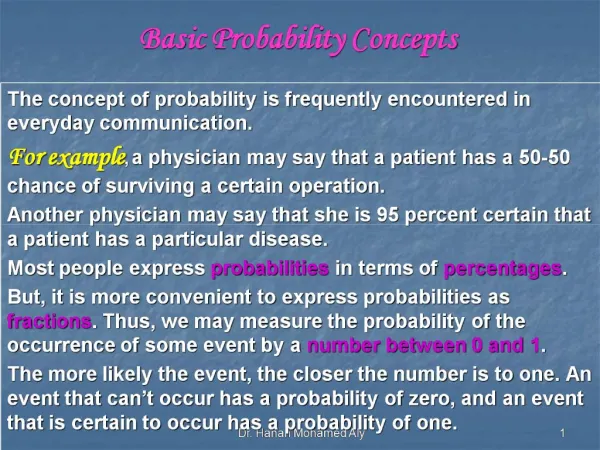
Basic probability Sample Space (S): set of all outcomes of an experiment Event (E): any collection of outcomes Probability of an event E, written as P(E) = The fraction of times the event E occurs out of large number trials
Properties 1. 0≤P(E)≤1 for any event, E. 2. P(E)=1 if E is certain to occur. 3.P(E F)=P(E) + P(F), If both E and F cannot happen at the same time. 4. P(S) = 1, if S is sample space
More properties For any Events E and F, • P(EF) = P(E) + P(F) – P(EF) • P(EC) = 1- P(E) • P(ECFC) = P((EF)C) = 1-P(EF) • P(ECFC) = P((EF)C) = 1-P(EF)
Important notation usage Let S be a sample space. For any events A and B, A or B means AB ( In A or in B or both) A and B means AB ( Common in A and B) A does not occur means AC ( Not in A)
Correct AB=S P(AC)= 1- P(A) P(A) + P(B) = .4 P({}) = 0 or P()=0 Not correct A + B = S AC = 1 – A A + B = .4 {} = 0 or = 0 Correct usage of Notation
Correct Mathematical expressions for the given statements Let S be a sample space. For any events E and F, • Probability that either E or F occurs = P(E F) 2. Probability that Neither E nor F occurs = P(EC FC) 3. Probability that exactly one event occurs = P(ECF)+ P(EFC) = [P(F)-P(EF)]+ [P(E)-P(EF)]