Download
1 / 10
100 likes | 200 Vues
This document outlines essential techniques in molecular biology, including the use of plasmids, PCR (Polymerase Chain Reaction), and restriction enzymes to manipulate DNA. It explains how to amplify specific DNA sequences, extract and insert genes, and analyze results using gel electrophoresis. With a focus on creating modular plasmids utilizing antibiotic resistance markers and dynamic promoters, this guide serves as a comprehensive overview for students and researchers interested in cloning and gene expression studies.

E N D
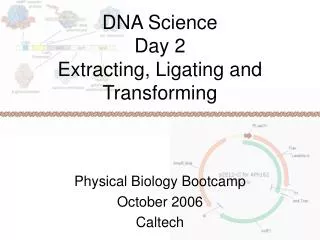
DNA ScienceDay 1Amplifying and Cutting APh162 Winter 2005 Caltech
What are the tools? • PCR = Xerox Machine • Amplify DNA • Restriction Enzymes = Scissors • Target very specific DNA sequences • Ligase = Glue • Transformation and DNA extraction
Making a modular plasmid • Copy number from 3 to 70 per cell • Four possible antibiotic resistances • Four promoters with three different inducers /HindIII Lutz and Bujard (1997)
The big picture • Extract the lacZ gene (our insert) from wild type E. coli (MG1655, GenBank U00096). • Put it into a pZE21 vector • colE1 origin of replication, 60-70 copies. • Kanamycin resistance • PLtetO-1, repressed by the Tet repressor and induced by tetracyclin (ATC) • Measure and compare the induction!
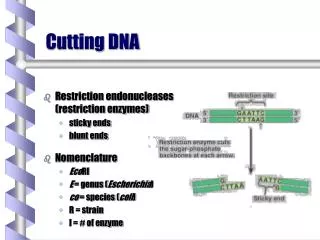
Doing a Restriction Digest • Lambda DNA (NC_001416) predigested by HindIII • Go to the NEB site • We’ll digest it with EcoRI • Obtain our vector by digesting pZE21-GFP with KpnI and HindIII • Run the results on an agarose gel. • Analyze our results • Extract certain DNA fragments (the vector)
Digestion Protocol • Lambda/HindIII: • 3 ul Lambda/HindIII (1.5 ug)5 ul NEBuffer EcoRI (10x)40 ul ddH2O2 ul EcoRI50 ul Total • Double Digest: • Start the cloning with ~3 ug of your vector • Just ~300 ng of DNA for the controls • (pg. 17) • Let sit for 2-3 hours at 37ºC
Polymerase Chain Reaction • Designing a primer • Adding a couple of sites • (APh162 Primer.doc) • The components and protocol • (InvitrogenAccuprimePFXSupermix.pdf) • Draw cycle! • 1. 95C for 5 min – DNAP activation2. 95C for 15 s – melting3. 65C for 30 s – anheling4. 68C for 3 min (min/kb) – elongation5. Go back to 2 for a total of 35 cycles6. Store at 4C • qPCR using SYBR green
Gel Electrophoresis • Preparing the samples: • <150 ng • Loading dye • DNA ladders (pg. 10) • Run 1% TAE gel at 100 V for ~80 min - +