Download
1 / 2
20 likes | 170 Vues
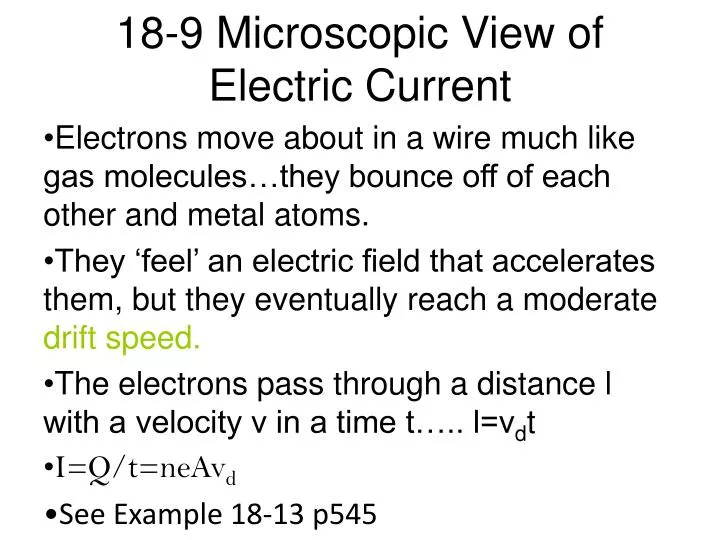
Electrons in a wire behave similarly to gas molecules, bouncing off each other and metal atoms. They are influenced by an electric field that accelerates them, leading to a steady drift speed. This motion can be described mathematically where distance (l) equals velocity (v) multiplied by time (t), leading to the equations for current (I) defined as charge (Q) over time (t), and the number of electrons (n) times their cross-sectional area (A) and drift speed (vd). Explore the intricacies of nerve conduction and the nervous system in relation to electrical phenomena.

E N D
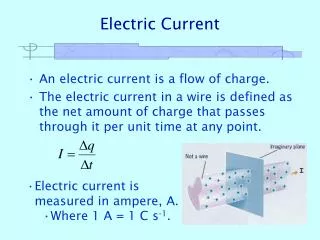
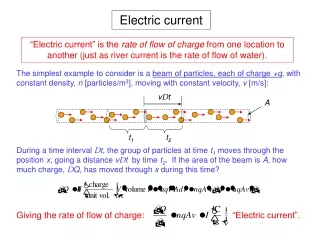
18-9 Microscopic View of Electric Current Electrons move about in a wire much like gas molecules…they bounce off of each other and metal atoms. They ‘feel’ an electric field that accelerates them, but they eventually reach a moderate drift speed. The electrons pass through a distance l with a velocity v in a time t….. l=vdt I=Q/t=neAvd See Example 18-13 p545
18-10 The Nervous System and Nerve Conduction • See Diagram and chart p 546 & 547 • See Example 18-14 p548