Understanding Food Accumulation Rates and Waste Decomposition Strategies
20 likes | 135 Vues
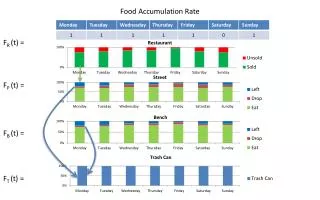
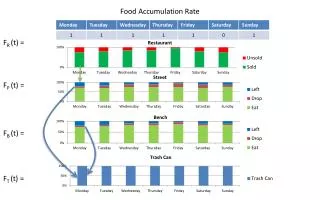
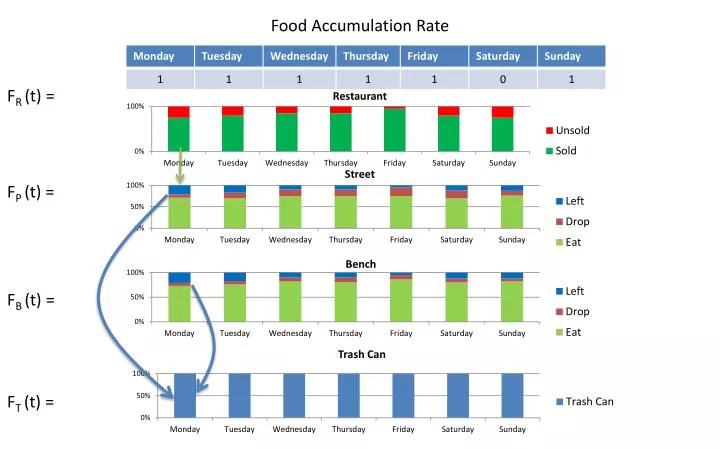
This study examines the food accumulation rate (FR) and its effect on waste decomposition in various environments. It explores how temperature and activation energy influence waste pick-up and decomposition rates for both dry (plastic, paper) and wet (food waste) streams. By analyzing mass balance and factors like time of day and location (e.g., restaurants, streets, benches, trash cans), we can gain insights into optimizing waste management practices. Key findings provide actionable steps for improving sustainability and efficiency in waste collection and decomposition.


Understanding Food Accumulation Rates and Waste Decomposition Strategies
E N D
Presentation Transcript
Food Accumulation Rate FR (t) = FP (t) = FB(t) = FT (t) =
T : TemperatureEa : Activation Energy Waste Pick-up (collection) Waste decomposition • Dry stream (plastic, paper) • Wet stream (food waste) • Decomposition rate Mass Balance of Food • 1 • 2 • 3 • 4 • Out • In • At day time • At night • At day time • At day time • (A) • Restaurant • FC1 • Street • FC2 • (D) • Bench • FC3 • (D) • FC4 • (B) • Trash Can