Download
1 / 5
50 likes | 198 Vues
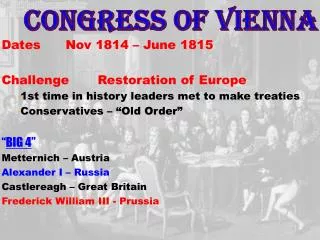
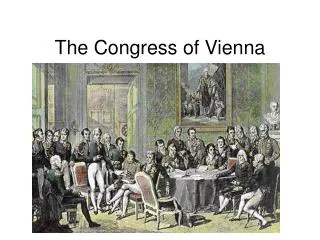
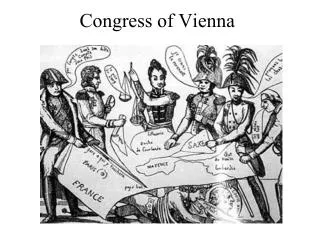
The Congress of Vienna (1814-1815) established key principles following the Napoleonic Wars, focusing on compensation, legitimacy, and a balance of power. Prominent figures like Prince Klemens von Metternich opposed nationalism and liberalism, advocating for absolute monarchies and stability in Europe. The Treaty of Paris on November 20, 1815, renewed the Quadruple Alliance, shifting its focus from defeating Napoleon to preserving the newly established order. The Holy Alliance, formed by Russia, Austria, and Prussia, aimed to promote Christian values in European politics, reinforcing conservative ideologies.

E N D
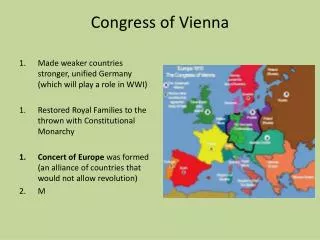
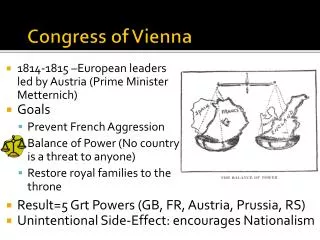
Guiding Principles • Compensation • Legitimacy (Monarchs) • Balance of Powers • Establish buffer states • Belgium • The Kingdom of The Netherlands • N. Italy—given to Austria • Rhineland—given to Prussia • Switzerland—given Independence
Prince Klemens Von Metternich • Opposed Nationalism • Opposed Liberalism • Defended absolute monarchies • Maintain a balance of Power • Liberalism: want change • Reactionaries or Conservatives: want monarchies—no change
Concert of Europe • Quadruple Alliance • a treaty signed in Paris on 20 November, 1815 by the United Kingdom, Austria, Prussia, and Russia. It renewed the alliance first agreed to in 1813 and it modified the aims of the alliance from defeating Napoleon Bonaparte to upholding the settlement following the Napoleonic Wars:
Holy Alliance • The Holy Alliance (also called the Grand Alliance) was a coalition of Russia, Austria and Prussia created in 1815 at the behest of Czar Alexander I of Russia, signed by the three powers in Paris on September 26, 1815, in the Congress of Vienna after the defeat of Napoleon. • instill the Christian values of charity and peace in European political life.