SlideServe
Menu
Préférences
© SlideServe · v2026

Birds In Uae

axelweston avatar
5 diapositives · 196 Views · Jun 07, 2017

To join houbara conservation UAE to conserve bird life just visit at http://www.houbarafund.org/en/info/uae
Birds In Uae - slide 1
01 / 5Birds In Uae
1 / 17

Télécharger la présentation

Birds In Uae
Une image / un lien ci-dessous est fourni (tel quel) pour télécharger la présentation

Politique de téléchargement : le contenu du site vous est fourni TEL QUEL pour votre information et votre usage personnel ; il ne peut être vendu, concédé sous licence ni partagé sur d’autres sites sans l’accord de son auteur.Le contenu vous est fourni TEL QUEL, pour votre information et votre usage personnel uniquement. Téléchargez la présentation en cliquant sur ce lien. Lors du téléchargement, si vous ne parvenez pas à télécharger une présentation, l’éditeur a peut-être supprimé le fichier de son serveur.Pendant le téléchargement, si vous ne parvenez pas à obtenir une présentation, le fichier a peut-être été supprimé par l’éditeur.

F I N

Plus de contenu associé

Transcription de la présentation
  1. Birds In UAE

  2. To join houbara conservation UAE to conserve bird life just visit at houbarafund.org.Join us if you want to conserve Houbara conservation camp through fund visit at houbarafund.org.

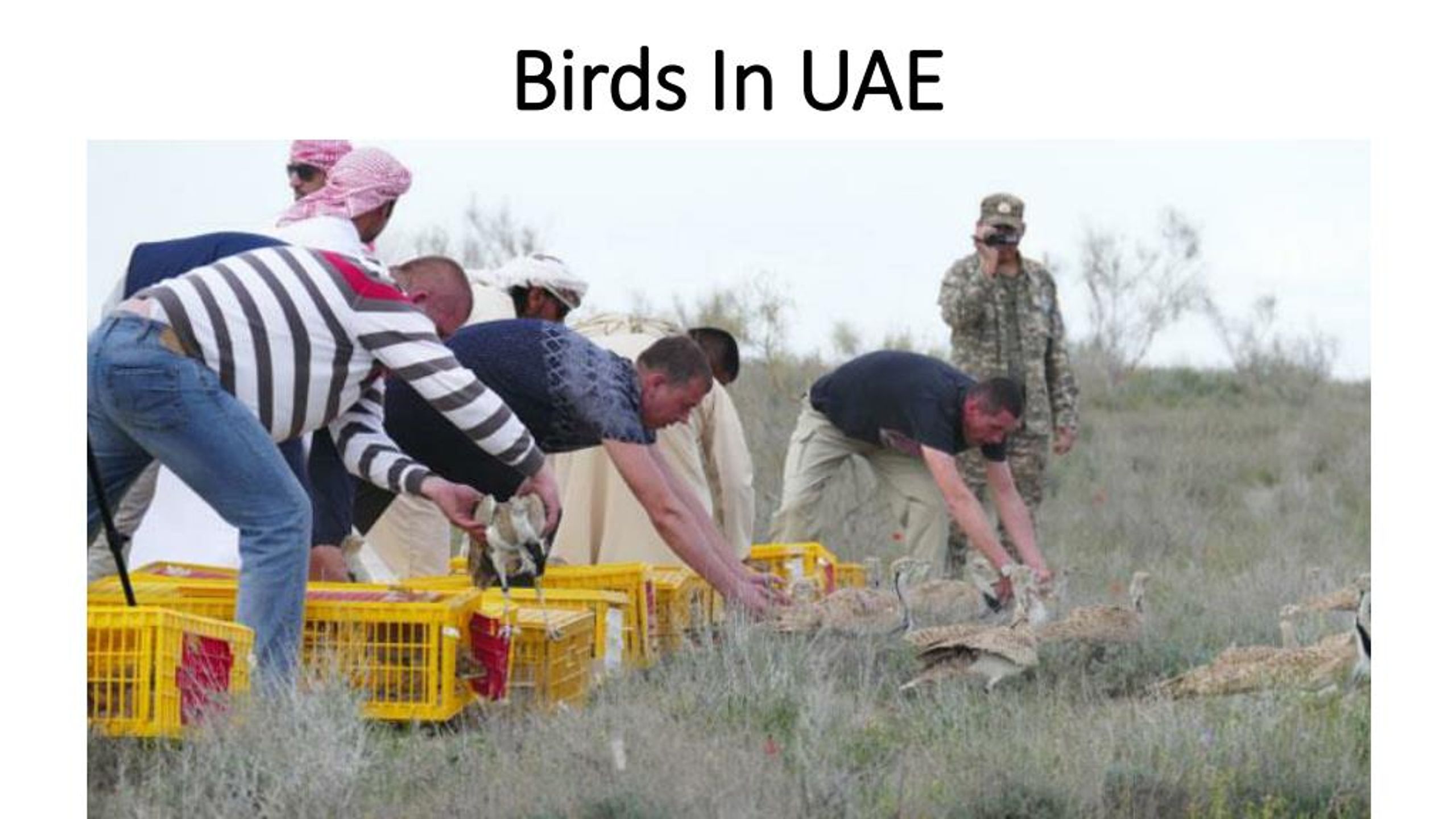
  3. Asian Houbara Houbara bustards are large-bodied birds with long legs and a slender neck. The upper body is speckled, sandy brown and the underside is creamy white. The male has long, black feathers around the back of his neck, and white feathers on the front, lower neck. Wide bands of distinct black and white occur on the wings and the square tail is sandy-brown with four distinct black bars.

  4. Arabian Bustard The Arabian Bustard (Ardeotisarabs) is a large, long-legged bird inhabiting arid environments across the Sahelo-Sudanese belt from Senegambia to Eritrea, with a small range extension on the Tihama plain on the south-western side of the Arabian Peninsula. Populations have declined drastically in Arabia. Currently, it seems probable that the only resident population on the Peninsula exists in Yemen. It is believed that the overall population is no more than 100 individuals, whose range does not exceed 1,000 km². The Arabian Bustard favours semi-arid and open grassy plains, arid bush country and savannah. In Yemen, the bird can also be found in cultivated areas. Birds in Yemen are known to seek cover in crops of sorghum and millet when the temperature peaks, indicating that cultivated crops provide some protection.

  5. To Know More About “Birds In Uae” Please Visit At:http://www.houbarafund.org/en/info/uae