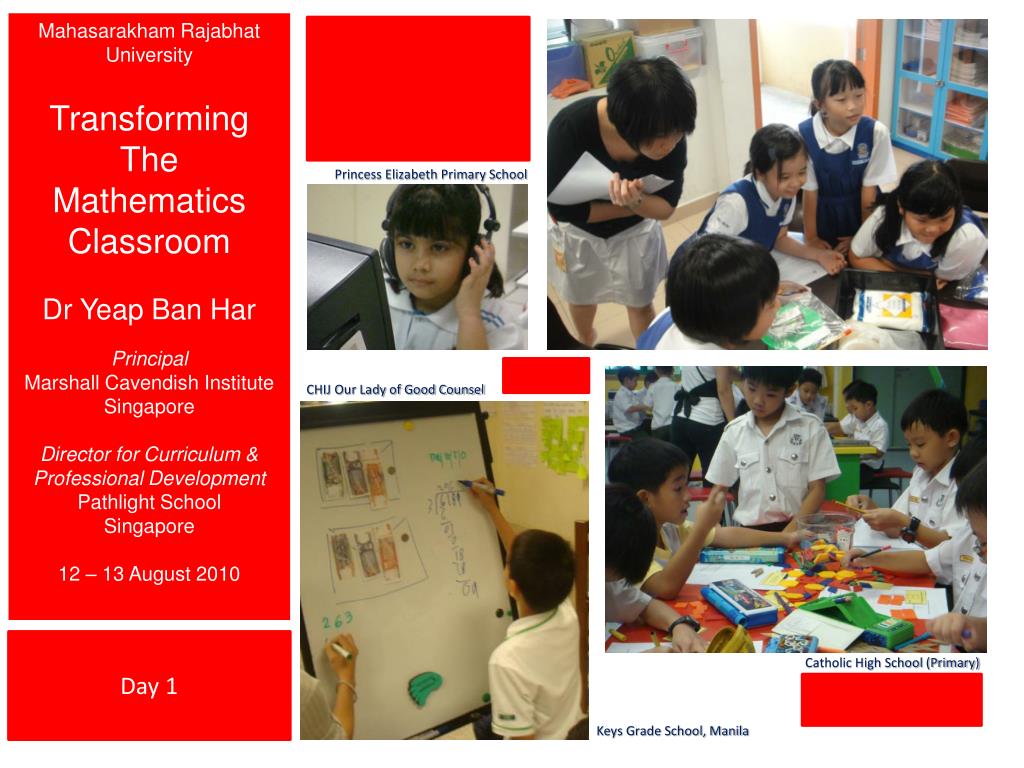
Mahasarakham Rajabhat University Transforming The Mathematics Classroom Dr Yeap Ban Har Principal Marshall C avendish Institute Singapore Director for Curriculum & Professional Development Pathlight School Singapore 12 – 13 August 2010. Princess Elizabeth Primary School.
Une image / un lien ci-dessous est fourni (tel quel) pour télécharger la présentation
Politique de téléchargement : le contenu du site vous est fourni TEL QUEL pour votre information et votre usage personnel ; il ne peut être vendu, concédé sous licence ni partagé sur d’autres sites sans l’accord de son auteur.Le contenu vous est fourni TEL QUEL, pour votre information et votre usage personnel uniquement.Téléchargez la présentation en cliquant sur ce lien.Lors du téléchargement, si vous ne parvenez pas à télécharger une présentation, l’éditeur a peut-être supprimé le fichier de son serveur.Pendant le téléchargement, si vous ne parvenez pas à obtenir une présentation, le fichier a peut-être été supprimé par l’éditeur.
F I N
Plus de contenu associé
Transcription de la présentation
MahasarakhamRajabhat University Transforming The Mathematics Classroom Dr Yeap Ban Har Principal Marshall Cavendish Institute Singapore Director for Curriculum & Professional Development Pathlight School Singapore 12 – 13 August 2010 Princess Elizabeth Primary School CHIJ Our Lady of Good Counsel Day 1 Catholic High School (Primary) Keys Grade School, Manila
Beliefs Interest Appreciation Confidence Perseverance Monitoring of one’s own thinking Self-regulation of learning Attitudes Metacognition Numerical calculation Algebraic manipulation Spatial visualization Data analysis Measurement Use of mathematical tools Estimation Mathematical Problem Solving Reasoning, communication & connections Thinking skills & heuristics Application & modelling Skills Processes Concepts Numerical Algebraic Geometrical Statistical Probabilistic Analytical Mathematics Curriculum Framework
Problem John had 1.5 m of copper wire. He cut some of the wire to bend into the shape shown in the figure below. In the figure, there are 6 equilateral triangles and the length of XY is 19 cm. How much of the copper wire was left?
Problem John had 1.5 m of copper wire. He cut some of the wire to bend into the shape shown in the figure below. In the figure, there are 6 equilateral triangles and the length of XY is 19 cm. How much of the copper wire was left? 150 cm – 19 cm x 5 = 150 cm – 95 cm = 55 cm 55 cm of the copper wire was left.
Problem In the diagram below, ABCD is a square and QM = QP = QN. MN is parallel to AB and it is perpendicular to PQ. Find MPN.
Problem In the diagram below, ABCD is a square and QM = QP = QN. MN is parallel to AB and it is perpendicular to PQ. Find MPN.
Problem In the diagram below, ABCD is a square and QM = QP = QN. MN is parallel to AB and it is perpendicular to PQ. Find MPN.
Problem In the diagram below, ABCD is a square and QM = QP = QN. MN is parallel to AB and it is perpendicular to PQ. Find MPN.
Problem In the diagram below, ABCD is a square and QM = QP = QN. MN is parallel to AB and it is perpendicular to PQ. Find MPN.
Why Teach Mathematics Mathematics is an “excellent vehicle to develop and improve a person’s intellectual competence”. Ministry of Education, Singapore 2006
Problem Mrs Hoon made some cookies to sell. 3/4 of them were chocolate cookies and the rest were almond cookies. After selling 210 almond cookies and 5/6 of the chocolate cookies, she had 1/5 of the cookies left. How many cookies did Mrs Hoon sell? 210
Problem Jim bought some chocolates and gave half of them to Ken. Ken bought some sweets and gave half of them to Jim. Jim ate 12 sweets and Ken ate 18 chocolates. After that, the number of sweets and chocolates Jim had were in the ratio 1 : 7 and the number of sweets and chocolates Ken had were in the ratio 1 : 4. How many sweets did Ken buy?
Problem Jim bought some chocolates and gave half of them to Ken. Ken bought some sweets and gave half of them to Jim. Jim ate 12 sweets and Ken ate 18 chocolates. After that, the number of sweets and chocolates Jim had were in the ratio 1 : 7 and the number of sweets and chocolates Ken had were in the ratio 1 : 4. How many sweets did Ken buy? Chocolates Sweets Jim 12 Ken 12 12 12 12 18
Teaching Place Value Activity • Combine your sets of digit cards. Shuffle the cards. • Take turns to draw one card at a time. • Place the card on your place value chart. • Once you have placed the card in a position, you cannot change its position anymore. • The winner is the one who makes the greatest number.
Place Value Key Concept: The value of digits depends on its place or position.
Practising Multiplication • Use one set of the digit cards to fill in the five spaces. • Make a correct multiplication sentence where a two-digit number multiplied by a 1-digit number gives a 2-digit product. • Make as many multiplication sentences as you can. • Are the products odd or even? x
Practicing Subtraction Activity 4 • Think of a number larger than 10 000 but smaller than 10 million. • Jumble its digits up to make another number. • Find their difference. • Write the difference on a piece of paper. Circle one digit. Add up the rest of the digits. • Tell me the sum of the rest of the digits and I will tell you the digit you circled. Example • 72 167 • 27 671 • 72 167 – 27 671 = 44 496 • 44 496 • 4 + 4 + 4 + 6 = 18 • Tell me 18.
MahasarakhamRajabhat University Transforming The Mathematics Classroom Dr Yeap Ban Har Principal Marshall Cavendish Institute Singapore Director for Curriculum & Professional Development Pathlight School Singapore 12 – 13 August 2010 Princess Elizabeth Primary School CHIJ Our Lady of Good Counsel Day 2 Catholic High School (Primary) Keys Grade School, Manila
effective mathematics teaching learning theories BinaBangsa School, Indonesia
Bruner Division The concrete pictorial abstract approach is used to help the majority of learners to develop strong foundation in mathematics. National Institute of Education, Singapore
Division Princess Elizabeth Primary School, Singapore
Connexion au compte
Connectez-vous pour publier votre contenu sur SlideServe.