Loudness
This article delves into the concepts of loudness, sound power, and sound intensity, explaining how sound intensity levels are measured. We explore the relationship between intensity and power, defined under the inverse square law, and introduce the decibel scale as a means of measuring sound levels. With insights into the physiological responses to sound and the damage thresholds of human hearing, we present sound level comparisons in various contexts, such as symphony concerts and background noise. The article also covers the cumulative effects of multiple sound sources.

Loudness
E N D
Presentation Transcript
Loudness Power, intensity, intensity level,
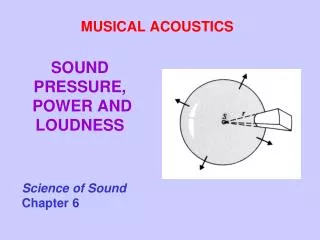
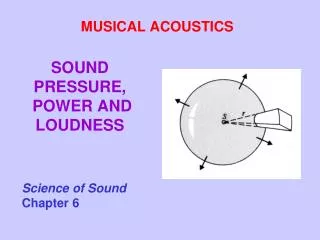
Power and intensity Sound detector 1J=1Nm Energy: will accumulate in time 1W=1J/s Power: rate of energy transfer, stays the same Dependent on detector area 1 W/m2=1J/sm2 Intensity: rate of energy transfer per area
Inverse Square Law B radius B = 2 radius A A area B = 4 area A intensity B = 1/4 intensity A
Sound intensity level • Physiological response to loudness does not simply scale with intensity • Loudest possible sound waves: • 1 Watt / square meter • Softest perceptible sound: • 10-12 Watt / square meter • Chosen as reference intensity
Sound intensity level • 1 Decibel=1/10 bel (Alexander Graham Bell) • “1 bel” for a sound means: • the ratio of its intensity to a reference is 10:1 Decibel measure the relation between two sounds, not an amount of sound.
Sound level and music • More than 50 dB (eliminates background) • Above 100 dB: damage to ears • ffff (95 dB) to ppp (50 dB) • More likely 60…85 dB for symphony concert • Determined by range of instruments (typically < 40dB) • Wood-wind: only 10 dB dynamic range
Sound levels and multiple sources What is the resulting sound level L? Violinist A IA=60 dB Violinist B IB=60 dB 10-6 W/m2 10-6 W/m2 (60+Log2) dB = 63 dB 2∙10-6 W/m2
Sound levels and multiple sources 10-6 W/m2 10-6 W/m2 10-6 W/m2 10-6 W/m2 10-6 W/m2 10-6 W/m2 10-6 W/m2 10-6 W/m2 10-6 W/m2 10-6 W/m2 What is the resulting sound level L? 10∙10-6 W/m2 10-5 W/m2 70 dB