DO NOW
DO NOW . What does the cell theory state? . Light Microscopes . Simple magnification and lenses Lenses magnify an object by bending the light that passes through them Curved shape is called convex Compound magnification These have more than one lens Resolution


DO NOW
E N D
Presentation Transcript
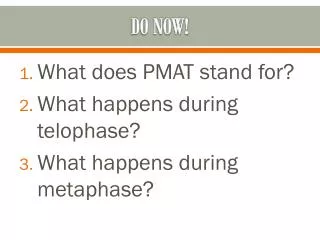
DO NOW What does the cell theory state?
Light Microscopes • Simple magnification and lenses • Lenses magnify an object by bending the light that passes through them • Curved shape is called convex • Compound magnification • These have more than one lens • Resolution • The ability to clearly distinguish between parts
Electron Microscope • Use a beam of electrons instead of light to produce a magnified image • Can get pictures of very small objects. • Resolution is much better than that of the light microscope.
Robert Hooke • Looked at cork • Named the cell
Anton van Leeuwenhoek • Was looking at water the same time that Hooke was looking at cork • He noticed that there were small things moving in the water
Schlieden, Schwann, Virchow • Schlieden said that all plants are made of cells • Schwann all animals are made of cells • Virchow said that cells come from existing cells • The three men created the cell theory
The Cell Theory • All living things are composed of cells • Cells are the basic units of structure and function in living things • All cells are produced from other cells
Cells • Tiny structures inside of a cell called organelles • Cell Wall • Only on plant cells and a few other organisms • Is a rigid layer of nonliving material that surrounds the cells • Protects and supports the cell • Made of cellulose • Water and Oxygen can pass through the cell easily
Cell • Cell Membrane • Barrier on the outside of all cells • Controls the substances that move in and out of the cell. • Forms boundaries that separates the cell from its environment • For a cell to survive the cell membrane must allow waste products out and nutrients in
DO NOW • Take out your homework • What is the difference between a cell membrane and a cell wall?
Nucleus • The control center of the cell, directing the activities • Nuclear envelope • Membrane that surrounds nucleus • Materials pass in and out through this • Chromatin • Contain genetic material • Contain instructions for the cells function • Nucleolus • Where ribosomes are made • Ribosomes make proteins which are important to the cell
Organelles in the Cytoplasm • Cytoplasm is located outside the nucleus • The area between the cell membrane and nucleus
Mitochondria • Rod-shaped structures • Known as the powerhouse of the cell • Convert energy in food molecules to energy the cell can use to carry out its function
Endoplasmic Reticulum • Carry proteins and other materials from one part of the cell to the other. • Can be smooth or rough
Ribosome • Attached to the surface of some parts of the endoplasmic reticulum • Some float in the cytoplasm • Small, grainlike bodies • Factories to produce proteins • Proteins go through the wall of the endoplasmic reticulum and then to the Golgi bodies.
Recap • What are the organelles that we discussed today? • What purpose does each serve? • Homework: Prepare for vocabulary quiz
DO NOW • What is the difference between smooth and rough ER? • Prepare for your vocabulary quiz.
Golgi Bodies • Looks like flattened sacs and tubes • Can be thought of as the mail room of the cell • Receive proteins and other newly formed materials from the endoplasmic reticulum, package them, and distribute them to other parts of the cell
Chloroplasts • Only found in plants and a few other organisms • Capture energy from the sunlight and use it to produce food for the cell
Vacuoles • Large water filled sacs • Storage areas of cells • Most plant cells have one large vacuole • Some animal cells have vacuoles and some do not • Store food and other materials needed, can also store waste
Lysosomes • Small, round structures containing chemicals that break down certain materials in the cell. • Can be called the cell’s clean-up crew
Specialized Cells • In multicellular organisms cells usually special and are organized into tissues, organs, and organ systems.
HOMEWORK • FINISH PACKET