Michigan’s Most Unwanted
200 likes | 323 Vues
Discover the invasive species threatening Michigan's ecosystems and how to identify them. Learn to differentiate between invasive invaders like Purple Loosestrife, Autumn Olive, and Multiflora Rose and their native counterparts including Michigan Holly and Fireweed. We'll explore the economic impacts, effects on biodiversity, and habitat alterations caused by these invaders. Additionally, understand the use of dichotomous keys for plant identification and make your own key to help tackle this challenge.


Michigan’s Most Unwanted
E N D
Presentation Transcript
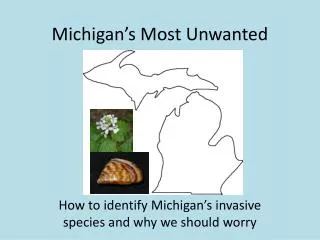
Michigan’s Most Unwanted How to identify Michigan’s invasive species and why we should worry
Can you identify the invaders? Suspect #1 Suspect #2 Suspect #4 Suspect #3
Can you identify the invaders? Dame’s rocket (invasive) Fireweed (native) Purple loosestrife (invasive) Foxglove (exotic)
How about this suspect list? Suspect #3 Suspect #1 Suspect #2 Suspect #4
How about this suspect list? Autumn olive (invasive) Canadian fly honeysuckle (native) Multiflora rose (invasive) Michigan Holly (native)
Who’s the invader? Suspect #1 Suspect #3 Suspect #2 Suspect #4
Who’s the invader? Round Goby Freshwater Dam Brook Trout Lake Whitefish
Who’s the invader? Suspect #1 Suspect #3 Suspect #2 Suspect #3 Suspect #1
Who’s the invader? Suspect #1 Suspect #3 Poison Hemlock (Conium maculatum) Hairy Angelica (Angelica venenosa) Purplestem Angelica (Angelica atropurpurea)
Why should we care? • Economic impacts $$$ • Impacts on native species and biodiversity • Habitat alteration
Dichotomous Keys Made Easy A dichotomous key is a reference tool used mainly in biology. It allows the user to determine what an organism is by answering numerous questions that have only two possible answers.
Decide how to separate what you are identifying into two groups by picking one character 1 Object is a shade of green…go to 2 1’ Object is a shade of blue…go to 4
Then choose one group and repeat…further dividing this group into two smaller subgroups 2 Object has 3 sides…triangle 2’ Object has 4 side…go to 3
Then choose another subgroup and further divide this into an even smaller subgroup 3 Object sides are all equal length…square 3’ Object has sides of two different lengths…rectangle
Repeat this pattern until all objects are identified 4 Object has rounded edges…circle 4’ Object has points…go to 5 5 Object has 5 sides…pentagon 5’ Object has 10 sides…star
Make your own key! Examine your plant samples - Decide how to break them up into groups to identify them Example of first grouping: 1 Plant is woody…go to 2 1’ Plant is herbaceous…go to 3
Lamprey Eels • Great Lakes invader • Threaten commercial fishing









![The ONCE and FUTURE [e-] JOURNAL](https://cdn0.slideserve.com/1357417/the-once-and-future-e-journal-dt.jpg)