
SlideServe
Menu
Préférences
© SlideServe · v2026

Understanding the Compartments of the Lower Leg: Structure, Function, and Blood Supply

baba avatar
31 diapositives · 502 Views · Jul 14, 2014

This comprehensive overview details the three compartments of the lower leg: anterior, lateral, and posterior. Each compartment is defined by its muscular structures, innervation, and blood supply. The anterior compartment houses dorsiflexors like Tibialis Anterior, whereas the lateral compartment consists of foot evertors including Peroneus Longus and Brevis. The posterior compartment contains the powerful plantar flexors such as Gastrocnemius and Soleus. Key anatomical relationships with the tibiofibular joints are highlighted, emphasizing their role in ankle stability.
Understanding the Compartments of the Lower Leg: Structure, Function, and Blood Supply - slide 1
01 / 31Understanding the Compartments of the Lower Leg: Structure, Function, and Blood Supply
1 / 17

Télécharger la présentation

Understanding the Compartments of the Lower Leg: Structure, Function, and Blood Supply
Une image / un lien ci-dessous est fourni (tel quel) pour télécharger la présentation

Politique de téléchargement : le contenu du site vous est fourni TEL QUEL pour votre information et votre usage personnel ; il ne peut être vendu, concédé sous licence ni partagé sur d’autres sites sans l’accord de son auteur.Le contenu vous est fourni TEL QUEL, pour votre information et votre usage personnel uniquement. Téléchargez la présentation en cliquant sur ce lien. Lors du téléchargement, si vous ne parvenez pas à télécharger une présentation, l’éditeur a peut-être supprimé le fichier de son serveur.Pendant le téléchargement, si vous ne parvenez pas à obtenir une présentation, le fichier a peut-être été supprimé par l’éditeur.

F I N

Plus de contenu associé

Transcription de la présentation
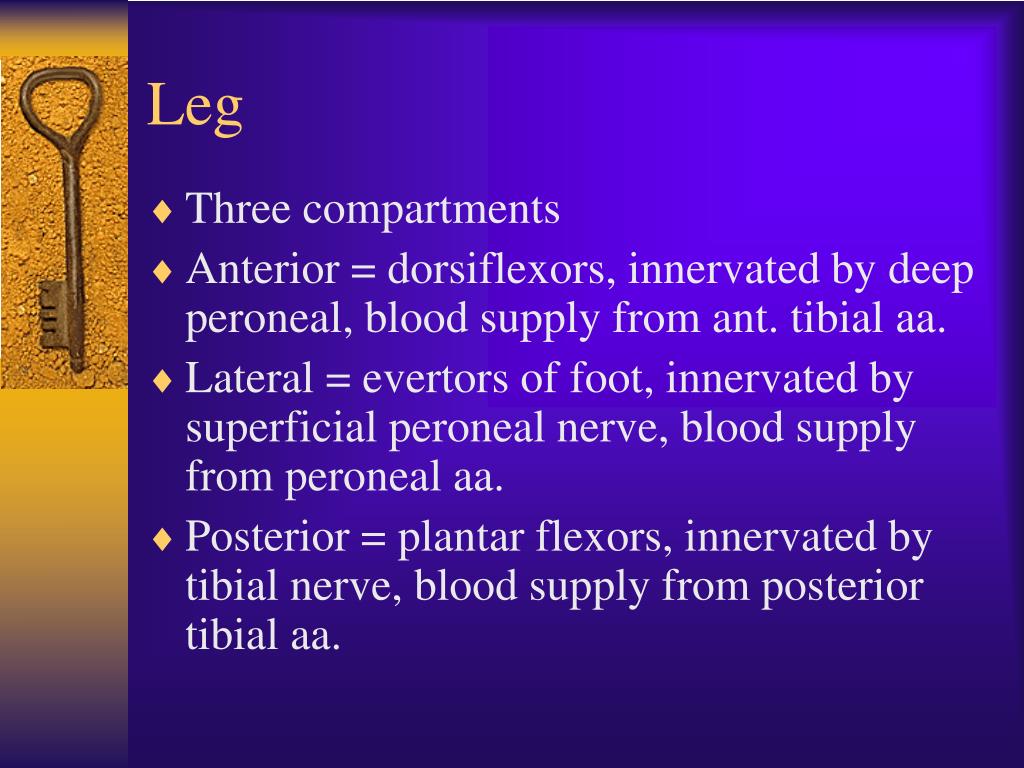
  1. Leg • Three compartments • Anterior = dorsiflexors, innervated by deep peroneal, blood supply from ant. tibial aa. • Lateral = evertors of foot, innervated by superficial peroneal nerve, blood supply from peroneal aa. • Posterior = plantar flexors, innervated by tibial nerve, blood supply from posterior tibial aa.

  2. Compartments

  3. Compartments

  4. Tibio-Fibular Joints • Proximal, Middle (Interossseous Membrane), Distal • Proximal = Head of Fibula with Lateral Condyle = Synovial Gliding A and P Ligaments • Middle = Interosseous Membrane = Fibrous - purpose • Distal = inferior fibula with inferior tibia – interosseous membrane and A and P Inferior tibiofibular ligaments – union and support essential for ankle stability

  5. Proximal T – F Joint

  6. Middle and Distal T – F Joints

  7. All Three

  8. Distal T- F Joint

  9. Distal T – F Joint

  10. Anterior Compartment • General Innervation/Blood supply • Muscles – note retinaculum • Tibilais Anterior • Extensor Hallicus Longus • Extensor digitorum longus • ? Extensor digitorum Brevis • Anterior compartment syndrome • Eccentric role of dorsiflexors drop foot

  11. Anterior Compartment Muscles

  12. Anterior Compartment

  13. Lateral Compartment • General innervation/blood supply • Muscles – note retinaculum • Peroneus (Fibularis) Logus • Peroneus Brevis • Peroneus Tertius

  14. Lateral Compartment

  15. Lateral Compartment

  16. Tendon Sheaths Lateral

  17. Posterior Compartment • Superficial, Intermediate and Deep • Superficial • Gastrocnemius • Plantaris • Intermediate • Soleus • Deep • Popliteus • Flexor digitorum longus • Flexor hallicus longus • Tibialis posterior

  18. Superficial/Inter. Muscles

  19. Superficial Muscles

  20. Intermediate Muscles

  21. Deep Muscles

  22. Deep Muscles

  23. Tendon Sheaths – Medial = Tom, Dick AN Harry

  24. Blood Supply

  25. Blood Supply

  26. Blood Supply

  27. Blood Supply

  28. Blood Supply

  29. Blood Supply

  30. Blood Supply

  31. Blood Supply