

SlideServe
Menu
Préférences
© SlideServe · v2026

CPS Question

babu avatar
18 diapositives · 372 Views · Sep 11, 2014

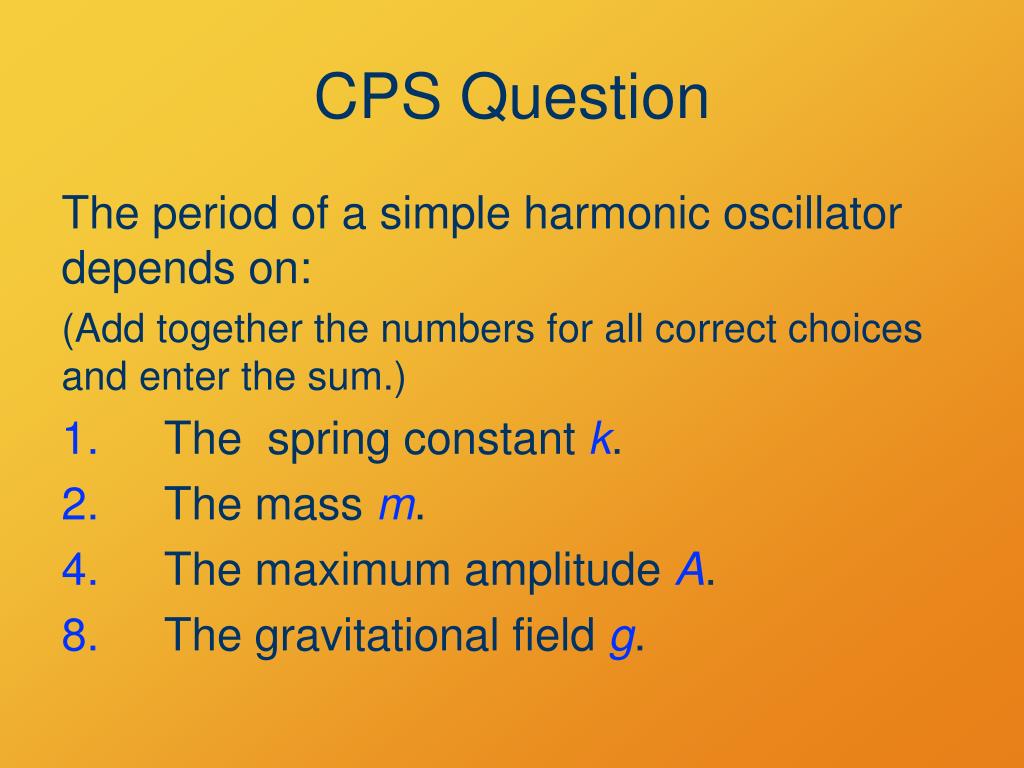
CPS Question. The period of a simple harmonic oscillator depends on: (Add together the numbers for all correct choices and enter the sum.) 1. The spring constant k . 2. The mass m . 4. The maximum amplitude A . 8. The gravitational field g. Pendulums. almost follow Hooke’s law.
CPS Question - slide 1
01 / 18CPS Question
1 / 17

Télécharger la présentation

CPS Question
Une image / un lien ci-dessous est fourni (tel quel) pour télécharger la présentation

Politique de téléchargement : le contenu du site vous est fourni TEL QUEL pour votre information et votre usage personnel ; il ne peut être vendu, concédé sous licence ni partagé sur d’autres sites sans l’accord de son auteur.Le contenu vous est fourni TEL QUEL, pour votre information et votre usage personnel uniquement. Téléchargez la présentation en cliquant sur ce lien. Lors du téléchargement, si vous ne parvenez pas à télécharger une présentation, l’éditeur a peut-être supprimé le fichier de son serveur.Pendant le téléchargement, si vous ne parvenez pas à obtenir une présentation, le fichier a peut-être été supprimé par l’éditeur.

F I N

Plus de contenu associé

Transcription de la présentation
  1. CPS Question The period of a simple harmonic oscillator depends on: (Add together the numbers for all correct choices and enter the sum.) 1. The spring constant k. 2. The mass m. 4. The maximum amplitude A. 8. The gravitational field g.

  2. Pendulums almost follow Hooke’s law § 13.4–13.6

  3. Angular Oscillations • Angular Hooke’s law: t = –kq • Angular Newton’s second law: t = Ia • So –kq =Ia • General Solution: q = Qcos(wt + f) • where w2 = k/I; Q and f are constants

  4. Group Work • MasteringPhysics problem 13.34

  5. Simple Pendulum L q m

  6. CPS Question The period of a simple pendulum depends on: (Add together the numbers for all correct choices and enter the sum.) 1. The length L. 2. The mass m. 4. The maximum amplitude Q. 8. The gravitational field g.

  7. L T = wR q wR = mg cosq q w = mg m wT = mg sinq Simple Pendulum Fnet = –wT = –mg sinq

  8. Small-Angle Approximation For small q (in radians) q sin q  tan q

  9. Simple Pendulum Fnet= –wT = –mg sinq t = –L mg sinq t  –L mg q = –kq k = Lmg I = mL2 L q m Lmg mL2 w2 = k/I = = g/L w is independent of mass m

  10. Group Work Find the length of a simple pendulum whose period is 2 s. About how long is the pendulum of a grandfather clock?

  11. Group Work • Do the lab.

  12. CPS Question If a pendulum is an extended object with its center of mass a distance L from the pivot, its period is • longer than • the same as • shorter than The period of a simple pendulum of length L.

  13. Physical Pendulum Source: Young and Freedman, Figure 13.23.

  14. w = k mgd = I I Physical Pendulum Fnet = –mg sinq tnet = –mgd sinq Approximately Hooke’s law t –mgdq

  15. New Powers • Now you can do MasteringPhysics problem 13.52

  16. Example: Suspended Rod Mass M, center of mass at L/2 Physical pendulum Simple pendulum L L L 2 2 1 1 3 4 I =  ML2 I =  ML2 harder to turn easier to turn

  17. Example Problem A pendulum is constructed of a circular disk pivoting at a point midway between its center of mass and its edge. What must its radius be for it to have a period of 1 s?

  18. Physical Pendulum • What is the period whend >> R?