Unleashing Data Visualization: Tools and Techniques for Effective Communication
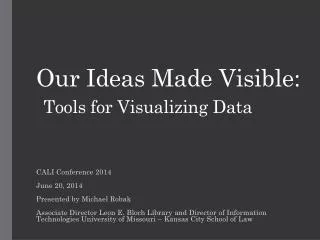
This presentation, by Michael Robak at the CALI Conference 2014, explores the importance of data visualization in interpreting complex information. Drawing on insights from notable figures like David McCandless and Edward Tufte, Robak emphasizes the transformative power of visualizing data, which turns abstract numbers into compelling narratives. He introduces various tools such as Tableau Public and Google Maps, highlighting their roles in creating effective visual displays. Discover how to communicate ideas with clarity and precision through effective data visualization strategies.

Unleashing Data Visualization: Tools and Techniques for Effective Communication
E N D
Presentation Transcript
Our Ideas Made Visible:Tools for Visualizing Data CALI Conference 2014 June 20, 2014 Presented by Michael Robak Associate Director Leon E. Bloch Library and Director of Information Technologies University of Missouri – Kansas City School of Law
Law Libraries are… DOOMED!
Why Data Visualization • As author, data journalist and information designer David McCandless said in his TED talk: • "By visualizing information, we turn it into a landscape that you can explore with your eyes, a sort of information map. And when you're lost in information, an information map is kind of useful."
The Master: Edward Tufte • http://www.edwardtufte.com/tufte/index • The Visual Display of Quantitative Information • http://www.amazon.com/The-Visual-Display-Quantitative-Information/dp/0961392142
Tufte’s “Principles of Graphical Excellence” • Graphical Excellence is the well-designed presentation of interesting data – a matter of substance, of statistics, and of design. • Graphical Excellence consists of complex ideas communicated with clarity, precision, and efficiency. • Graphical Excellence is that which gives to the viewer the greatest number of ideas in the shortest time with the least ink in the smallest space. • Graphical Excellence is nearly always multivariate • And Graphical Excellence requires telling the truth about the data
Tufte • Napoleon’s March • http://www.edwardtufte.com/tufte/posters
Tufte • PowerPoint is Evil • http://www.wired.com/wired/archive/11.09/ppt2.html
Richard Saul Wurman and Walter Mossberg • http://www.businessinnovationfactory.com/iss/video/bif3-richard-saul-wurman
In the fields of computational linguistics and probability, an n-gram is a contiguous sequence of n items from a given sequence of text or speech. The items can be phonemes, syllables, letters, words or base pairs according to the application. The n-grams typically are collected from a text or speech corpus.
http://books.google.com/books?id=VoA8AAAAIAAJ&printsec=frontcover&dq=william+taylor+hughes+technology+of+law&hl=en&sa=X&ei=5jtEUtWuFozs8ATRgYHYBQ&ved=0CDgQ6AEwAA#v=onepage&q=william%20taylor%20hughes%20technology%20of%20law&f=falsehttp://books.google.com/books?id=VoA8AAAAIAAJ&printsec=frontcover&dq=william+taylor+hughes+technology+of+law&hl=en&sa=X&ei=5jtEUtWuFozs8ATRgYHYBQ&ved=0CDgQ6AEwAA#v=onepage&q=william%20taylor%20hughes%20technology%20of%20law&f=false
Go to Chrome • https://books.google.com/ngrams
Wordle http://www.wordle.net/
Community analyst online http://laurel.lso.missouri.edu/search~S3/j Video explanation: http://video.arcgis.com/watch/3079/using-the-find-location-tool-in-community-analyst
Google Maps https://maps.google.com/?mid=1393537505
https://maps.google.com/maps/ms?msa=0&msid=112814580544975292567.000463ecdfc0c9c200ddb&ie=UTF8&ll=39.909736,-102.128906&spn=29.823004,56.601563&z=4&dg=featurehttps://maps.google.com/maps/ms?msa=0&msid=112814580544975292567.000463ecdfc0c9c200ddb&ie=UTF8&ll=39.909736,-102.128906&spn=29.823004,56.601563&z=4&dg=feature
Tableau Public http://www.tableausoftware.com/public
Visualize free http://visualizefree.com/index.jsp
Many Eyes http://www-958.ibm.com/software/data/cognos/manyeyes/
Easel.ly http://www.easel.ly/