Download
1 / 12
120 likes | 244 Vues
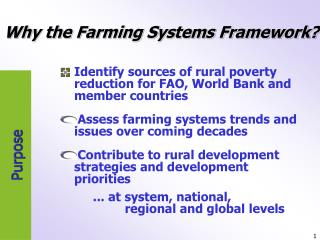
The Farming Systems Framework aims to identify sources of rural poverty reduction for organizations such as FAO and the World Bank. It assesses farming systems' trends and issues over coming decades while contributing to various rural development strategies at system, national, regional, and global levels. By focusing on sustainable livelihoods and broad driving forces of farming systems, the framework analyzes household strategies and categories of farming systems—including case studies that highlight effective poverty reduction strategies and the implementation of best practices in diverse contexts.

E N D
Why the Farming Systems Framework? • Identify sources of rural poverty reduction for FAO, World Bank and member countries • Assess farming systems trends and issues over coming decades • Contribute to rural development strategies and development priorities ... at system, national, regional and global levels Purpose
Farm Household Focus Sustainable livelihoods (five capitals, vulnerability, processes) Broad driving forces of evolution of farming systems (resources, technologies, policies, markets, information) Household strategies (intensification of existing production patterns, diversification of livelihoods, expanded farm or herd size, increased off-farm income, exit from agriculture) Household focus
Farming Systems and Case Studies • Categories of farming systems (8) • Farming systems defined (72) • AEZ, irrig, markets, institutions, .... • Key systems analyzed (20) • supporting 2 billion farm women, men and children • Case studies, illustrative (21) Farming systems
Four levels of aggregation • Global (i.e., all 6 developing regions) • Farming system category (e.g., Rainfed Highland) • Region (e.g., sub-Saharan Africa) • Farming System (e.g., Maize Mixed Farming System in East Africa) Aggregation
Farming Systems Categories: Cultivated Area System categories
Diversification Intensification 30% 20% Exit Farm Size 10% 20% Off-Farm Income 20% Maize Mixed System Household Poverty Reduction Strategies System poverty reduction
Applying the Framework at Different Scales Global and Regional: Determining regional priorities Dissemination of best practices Monitoring and impact assessment Sub-Regional: Scope and priorities for multi-country programmes National: Rural development strategies and policies Poverty Reduction Strategy Papers (PRSPs) Project formulation Implementation
Selecting Areas of Best Practice By farming systems and by FS categories Technology adoption:Effective conservation, production, and post-harvest technologies Innovative marketing and other services:small-enterprise promotion, mechanisms for service provision Policies and institutions:Decentralised decision making, private/public partnerships Global/Regional
Refining the Farming Systems Framework and Maps at National Level: BRAZIL Dryland Mixed FS Coastal FS Forest Based FS Extensive Mixed FS Intensive Mixed FS Campos FS
Strengthening National Rural Strategies Increase the rural content of national poverty reduction efforts: National rural development strategies PRSPs, COSOPs, and other targeting instruments Through: Analysing data across administrative boundaries Multi-layered national farming systems atlas Investments that better respond to priorities and needs of poor farmer National
For further information... Book and Summary: “Farming Systems and Poverty: Improving farmers’ livelihoods in a changing world” (available from the World Bank and FAO) Website: www.fao.org/FarmingSystems/ Further information