Scientific Method and Lab Safety Study Guide
This study guide covers the fundamentals of the scientific method and essential lab safety protocols using true or false questions. It highlights key concepts such as the importance of observations, proper communication of results, the necessity of safety equipment like gloves and goggles, and best practices for handling materials in the lab. It provides a helpful tool for students to test their understanding of scientific inquiry and ensure a safe working environment. Essential for anyone preparing for science experiments or laboratory sessions.

Scientific Method and Lab Safety Study Guide
E N D
Presentation Transcript
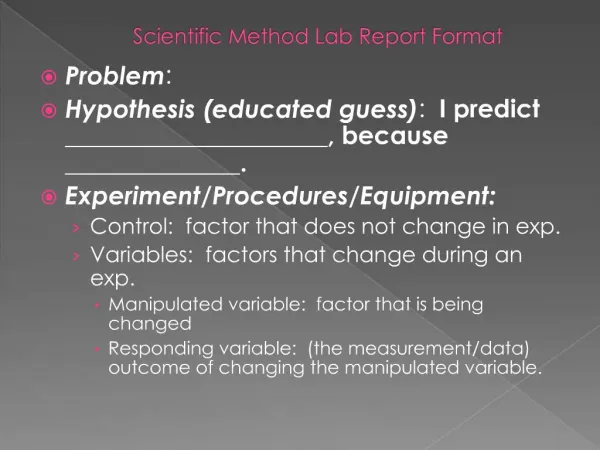
Question • The scientific method is a series of steps that scientist use to answer questions and solve problems. • True
Question • An observation is when you tell your friends about what happened. • False; Communicating Your Results (Scientific Method)
Question • You should not communicate the results of your experiment because others will copy you. • False
Question • You should not record your observations. • False
Question • A hypothesis is a possible explanation or answer to the question. • True (Remember Hypothesis Hippopotamus!—BIG IDEA!)
Question • You should always do your own experiments instead of the ones that your teacher instructs you to do. • False
Question • Hand safety includes wearing gloves. • True
Question • We do not have an eye wash station in this classroom. • True (Not a REAL eye wash station like this!)
Question • If you have long hair it is okay to leave it down during a lab. • False
Question • You can eat or drink while in the lab. • False
Question • Make sure you don’t wash your hands after handling an animal. • False (Eeeew)
Answer this Question: • How should you cut objects in the lab? • On a hard, flat surface, away from yourself and others.
Answer this Question: • Where should all of your books and notebooks be during a lab? • Under your lab table and out of the way.
Answer this Question: • What should you do if glassware at your table is broken? • Tell the teacher, and get new glassware.
Answer this Question: • When should you wear safety goggles in the lab? • Whenever there is even the slightest chance harm could come to your eyes.
Answer this Question: • Where should all electrical cords be during a lab? • Placed carefully and taped down so it can’t trip people, or knock over lab equipment if accidently pulled.
Answer this Question: • If a liquid is spilled, what should you do? • Call the teacher immediately, if a chemical spills on you, rinse with water for 5 minutes.
Answer this Question: • Where is the sink in this room and the closest water fountain? • Up front (sink) and in the hall by Mr. Pitts’ room (drinking fountain).