The Winter Struggles of 1778: Washington's Resolve at Valley Forge
180 likes | 315 Vues
In the harsh winter of 1778, General George Washington and his Continental Army endured unimaginable hardships at Valley Forge, enduring shortages of food, clothing, and shelter while remaining just miles from British forces in Philadelphia. This pivotal moment came as news of a French alliance provided hope for the beleaguered soldiers. Despite facing desertion and morale issues, Washington’s leadership, bolstered by incoming aid from international allies like France and Spain, would strengthen the Patriot cause, turning the tide of the Revolutionary War.


The Winter Struggles of 1778: Washington's Resolve at Valley Forge
E N D
Presentation Transcript
The Revolutionary War Continues 6.2 By: David And Andrew
A Difficult Winter • Spring 1778 word of the French-alliance reached the United States • Meanwhile, British general Howe and his forces spent the winter in comfort in Philadelphia • Washington set up camp at Valley Forge • 20 miles west of the British • Washington and his troops endured a winter of terrible suffering • lack of decent food, clothing, and shelter • Washington's greatest challenge was keeping the Continental Army together
Objectives • At the end of the section each student MUST be able to: • Tell how the Patriots receive help from • other nations • Tell how Washington's troops survived the winter at Valley Forge • Describe the challenges Americans faced at home as a result of the war
Terms To Know Desert – left without permission Inflation – takes more and more money to buy the same amount of goods
Gaining Allies • 1777, Benjamin Franklin had been in Paris for a year, trying to get the French to support the Americans in the war. • With Franklin’s skill and charm he made many friends in the United States. • Franklin was so good he persuaded the French to send money to the Americans secretly , but they would not form an alliance.
France • News of the American victory at Saratoga caused a shift in Frances policy. • France announced support for the U.S. openly after realizing the Americans could have a chance at beating Great Britain. • February 1777, the French and the Americans worked out a trade agreement and an alliance. • France declared war on Britain and sent money, troops, and equipment to aid the American Patriots.
Spain and the Netherlands • Other European nations helped the American cause, mostly because they hated the British • 1779, the Spanish declared war on Britain. • Bernardo de Galvez was the Spanish governor of Louisiana. • Galvez sent money, rifles and other supplies to American troops in Virginia and Ohio. • The Netherlands then went to war with Britain and Dutch bankers lent money to the American troops
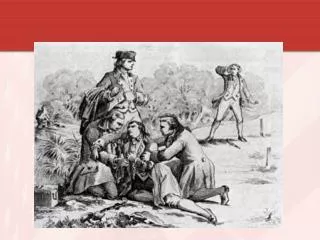
Winter at Valley Forge • Joseph Martin, a 17-year-old private • from Connecticut • spent the winter at Valley Forge • The men lacked blankets, shoes, and shirts • Martin made a rough pair of moccasins out of a scrap of cowhide • they were better then walking bare foot • Many men deserted the Continental Army while at Valley Forge • Some officers resigned and the army was falling apart
Winter at Valley Forge • Some how the Continental Army survived the winter and conditions improved • Troops built huts and gathered supplies from the country side • Volunteers made clothes for the troops and cared for the sick • New soldiers joined the ranks in the spring • April 1778, Washington told his troops about the alliance with France • Everyone's spirits rose at the thought of help from overseas
Help from over seas • Marquis de Lafayette was a French nobleman/soldier at Valley Forge • Lafayette brought a ship and set sail to America • He rushed to join the battle for freedom • He was prohibited not to by King Louis XIV • When Lafayette arrived in Philadelphia, he offered his services and his followers to General Washington • Lafayette become a trusted aide to Washington • Thaddeus Kosciuszko, an engineer, and Casmir Pulaski, a cavalry officer-contributed to American efforts
Help from over seas • Pulaski died in 1780 fighting for the Continental Army in the south • Friedrich von Steuben • former army officer from Germany • taught military discipline to troops at Valley Forge • turned the Continental Army into a more effective fighting force • Juan de Miracles arrived in Philadelphia in 1778 as a representative of Spain • Spain, Cuba, and Mexico sent financial aid to the colonies. • Miralles befriended many Patriot leaders and lent them money for their cause.
Money Problems • Getting money to finance the war was a huge concern • The Continental Congress had no power to raise money through taxes • Much more money was needed than what they were getting for other countries • To pay for the war, Congress printed paper money • These money lost their value after a while • This happened because the circulation grew faster than the amount of gold and silver
Money Problems • This led to inflation or more and more money to buy the same amount of goods • Congress stopped making this money cause no one was using it • Americans had no other way of finance for the war
Life on the Home Front • The war had a major impact on all the Americans • With thousands of men in the Army service women took the duties that the men had • they took over the businesses of their husbands • Abigail Adams was one of the women who managed a farm while her husband was away • Betsy Ross, made the first American flag for George Washington
Changing Attitudes • Women questioned their role in society • Judith Sargent Murray argued that women's minds were just as good as men's • Girls then received the same education boys did • Abigail Adams wrote a letter to her husband, John Adams, about equality
Treatment of Loyalists • Thousands of loyalists fought for the British against the Patriots • There were loyalists in every state • Some loyalist spied and informed the British of information upon the patriots • Some loyalists fled the American colonies • Loyalists who remained faced difficult times • Loyalists who helped the British were then called traitors • Some were tortured beaten, or even killed
Hopes for Equality • The war inspired some Americans to question slavery • The Boston town meeting voted to condemn slavery • 1778, Governor William Livingston of New Jersey as to free all enslaved people • African Americans had the same argument • Vermont, New Hampshire, Massachusetts, and Pennsylvania tried to end slavery • However the issue of slavery would remain unsettled
Objectives • At the end of the section each student MUST be able to: • Tell how the Patriots receive help from other nations? • Tell how did Washington's troops survive the winter at Valley Forge? • Describe the challenges Americans face at home as a result of the war?