Understanding Propaganda: Techniques, Impacts, and Media Influence
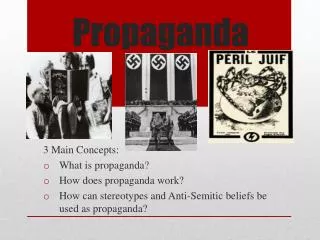
Propaganda is information designed to manipulate public opinion, often biased and emotion-driven. It aims to persuade us to accept ideas without critical examination, commonly disseminated through influential media. This can be seen in advertising, politics, public relations, and wartime communication. Techniques such as testimonials, glittering generalities, plain folks, and more are used to sway opinions. Awareness of these methods can help individuals discern the information presented to them and engage more thoughtfully with media narratives.

Understanding Propaganda: Techniques, Impacts, and Media Influence
E N D
Presentation Transcript
Propaganda is… • Information intended to manipulate public opinion. • Bias rather than impartial. • Usually spread by the media in an effort to help or harm a person, group, institution, act, or idea. • May be covert or conspicuous.
Propaganda is… • Intended to make us accept or approve something without looking closely at the evidence. • Usually appeals to emotion rather than intellect • The desired effect is a swayed opinion.
Propaganda and the Media • Propagandists typically use media that reach a large population of people • Where do you see propaganda?
Forums for Propaganda • Advertising • Where do you see advertisements? • Politics • How so? • War • Why would this be necessary? • Public Relations
What are possible benefits and dangers of propaganda?
Common Techniques • Testimonial • Glittering Generalities • Transfer • Plain Folks • Bandwagon • Name Calling • Card Stacking
Testimonial • A respected person sanctions a product or idea • Either a celebrity or an “everyman” • Celebrity testimonials associate fame with the product • Everyman testimonials allow the audience to relate to the product • Emotional in nature; don’t appeal to logical reasoning.
Glittering Generalities • Use intensely appealing words to make a product or idea seem attractive without really offering supporting information or reason. • Purposefully vague • Use words like low fat, better, new, honor, prosperity, etc.
Transfer • Relates something or someone we like with a product • Designed to make you feel the same way about the product as you do about its associated symbol or person • Symbols are often a huge part
Plain Folks • Use everyday people to sell a product • Designed to win the confidence of the audience • Use ordinary language and images, avoiding foreign sounding technical terms and jargon
Bandwagon • Attempts to persuade the target audience to “do what everyone else is doing." • Reinforces the natural desire to be on the “winning side” • Appeals to the conformist
Name Calling • The use of names that evoke fear or hatred in the viewer. • Links a person or idea to a negative symbol. • Uses obviously negative terms (bum, Fascist) or words with a negative connotation (radical, counter-culture)
Card Stacking • Shows the product’s or idea’s best features, tells half-truths, and omits or lies about its potential problems. • Carefully selects the facts that will make the product or idea seem positive
Terms to Know • Audience • Bias • Connotation • Credibility • Implied • Purpose • Tone • Persuasion • Fallacy • Objectivity