Understanding Ownership Structures and Investment Strategies in Financial Statements
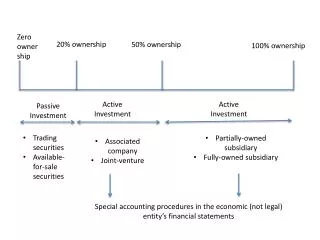
Explore the various ownership levels, including 20%, 50%, and 100% ownership, and their implications on financial reporting. Learn about active versus passive investment strategies and their impact on performance. Discover the significance of trading securities, available-for-sale securities, and the distinction between partially-owned and fully-owned subsidiaries. Uncover the role of associated companies and joint ventures, and the special accounting procedures necessary for accurately representing these entities in economic (not legal) financial statements.

Understanding Ownership Structures and Investment Strategies in Financial Statements
E N D
Presentation Transcript
Zero ownership 20% ownership 50% ownership 100% ownership Active Investment Active Investment Passive Investment • Trading securities • Available-for-sale securities • Partially-owned subsidiary • Fully-owned subsidiary • Associated company • Joint-venture Special accounting procedures in the economic (not legal) entity’s financial statements