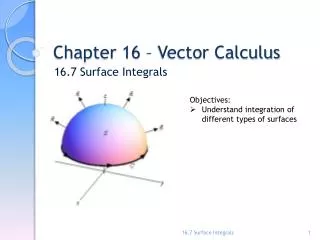
Chapter 16 – Vector Calculus
Chapter 16 – Vector Calculus. 16.7 Surface Integrals. Objectives: Understand integration of different types of surfaces. Surface Integrals. The relationship between surface integrals and surface area is much the same as the relationship between line integrals and arc length.

Chapter 16 – Vector Calculus
E N D
Presentation Transcript
Chapter 16 – Vector Calculus 16.7 Surface Integrals • Objectives: • Understand integration of different types of surfaces 16.7 Surface Integrals
Surface Integrals • The relationship between surface integrals and surface area is much the same as the relationship between line integrals and arc length. 16.7 Surface Integrals
Surface Integrals • Suppose a surface S has a vector equation r(u, v) = x(u, v) i+ y(u, v) j + z(u, v) k (u, v) D 16.7 Surface Integrals
Surface Integrals • In our discussion of surface area in Section 16.6, we made the approximation ∆Sij ≈ |rux rv| ∆u ∆v where: are the tangent vectors at a corner 16.7 Surface Integrals
Surface Integrals - Equation 2 • If the components are continuous and ruand rv are nonzero and nonparallel in the interior of D, it can be shown that: 16.7 Surface Integrals
Surface Integrals • Formula 2 allows us to compute a surface integral by converting it into a double integral over the parameter domain D. • When using this formula, remember that f(r(u, v) is evaluated by writing x =x(u, v), y =y(u, v), z =z(u, v) in the formula for f(x, y, z) 16.7 Surface Integrals
Example 1 • Evaluate the surface integral. 16.7 Surface Integrals
Graphs • Any surface S with equation z =g(x, y) can be regarded as a parametric surface with parametric equations x =x y =y z =g(x, y) • So, we have: 16.7 Surface Integrals
Graphs • Therefore, Equation 2 becomes: 16.7 Surface Integrals
Graphs • Similar formulas apply when it is more convenient to project Sonto the yz-plane or xy-plane. • For instance, if Sis a surface with equation y =h(x, z) and D is its projection on the xz-plane, then 16.7 Surface Integrals
Example 2 – pg. 1145 # 9 • Evaluate the surface integral. 16.7 Surface Integrals
Oriented Surface • If it is possible to choose a unit normal vector n at every such point (x, y, z) so that n varies continuously over S, then • S is called an oriented surface. • The given choice of n provides S with an orientation. 16.7 Surface Integrals
Possible Orientations • There are two possible orientations for any orientable surface. 16.7 Surface Integrals
Positive Orientation • Observe that n points in the same direction as the position vector—that is, outward from the sphere. 16.7 Surface Integrals
Negative Orientation • The opposite (inward) orientation would have been obtained if we had reversed the order of the parameters because rθ x rΦ = –rΦ x rθ 16.7 Surface Integrals
Closed Surfaces • For a closed surface—a surface that is the boundary of a solid region E—the convention is that: • The positive orientation is the one for which the normal vectors point outward from E. • Inward-pointing normals give the negative orientation. 16.7 Surface Integrals
Flux Integral (Def. 8) • If F is a continuous vector field defined on an oriented surface S with unit normal vector n, then the surface integral of F over Sis: • This integral is also called the flux of Facross S. 16.7 Surface Integrals
Flux Integral • In words, Definition 8 says that: • The surface integral of a vector field over Sis equal to the surface integral of its normal component over S (as previously defined). 16.7 Surface Integrals
Flux Integral • If Sis given by a vector function r(u, v), then n is • We can rewrite Definition 8 as equation 9: 16.7 Surface Integrals
Example 3 – pg. 1145 # 26 • Evaluate the surface integral for the given vector field F and the oriented surface S. In other words, find the flux of F across S. For closed surfaces, use the positive (outward) orientation. 16.7 Surface Integrals
Vector Fields • In the case of a surface Sgiven by a graph z =g(x, y), we can think of x and y as parameters and write: • From this, formula 9 becomes formula 10: 16.7 Surface Integrals
Vector Fields • This formula assumes the upward orientation of S. • Fora downward orientation, we multiply by –1. 16.7 Surface Integrals
Example 4 • Evaluate the surface integral for the given vector field F and the oriented surface S. In other words, find the flux of F across S. For closed surfaces, use the positive (outward) orientation. 16.7 Surface Integrals
Other Examples • In groups, please work on the following problems on page 1145: #’s 12, 14, and 28. 16.7 Surface Integrals
Example 5 – pg. 1145 # 12 • Evaluate the surface integral. 16.7 Surface Integrals
Example 6 – pg. 1145 # 14 • Evaluate the surface integral. 16.7 Surface Integrals
Example 7 – pg. 1145 # 28 • Evaluate the surface integral for the given vector field F and the oriented surface S. In other words, find the flux of F across S. For closed surfaces, use the positive (outward) orientation. 16.7 Surface Integrals




![Chapter 3: Relational Model and Relational Algebra & Calculus ( [S] Chp . 2 and 5 )](https://cdn2.slideserve.com/4283663/chapter-3-relational-model-and-relational-algebra-calculus-s-chp-2-and-5-dt.jpg)