Download
1 / 26
260 likes | 371 Vues
This presentation discusses the investigation of rare B decays at the Tevatron, highlighting the challenges and methodologies employed by the CDF and DØ collaborations. Flavor Changing Neutral Currents (FCNCs) are emphasized as a significant area of study due to their suppression at tree level and the prospects of revealing new physics through their measurement. We present the experimental setups, selection criteria, and results from di-muon triggered data, along with the implications of findings in the context of the Standard Model and beyond.

E N D
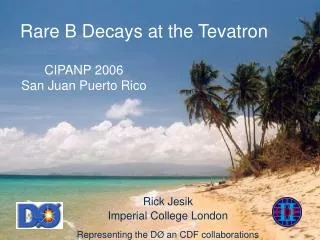
CIPANP 2006San Juan Puerto Rico Rare B Decays at the Tevatron Rick Jesik Imperial College London Representing the DØ an CDF collaborations
Flavor changing neutral currents • FCNC’s are forbidden at tree level, Bgl+l- decays are also helicity suppressed • SM: BR(Bsgm+m-) ~ 3.410-9 • depends only on one SM operator in effective Hamiltonian, hadronic uncertainties are small • Bd relative to Bs suppressed by |Vtd/Vts|2 ~ 0.04 if no additional sources of flavor violation • Taus are difficult to detect, muon modes provide easy trigger SM expectations:
New physics in FCNC’s • excellent probe for new physics • tiny SM branching ratio with small theoretical uncertainty • particularly sensitive to models with extended Higgs sector • BR grows ~ tan6b (up to 3 orders of magnitude) in MSSM • 2HDM models ~ tan4b • mSUGRA: BR correlated with shift of (g-2)m - BNL measurement implies a factor of 10-100 enhancement. • Many other scenarios can contribute • minimal SO(10) GUT models • Rp violating models, contributions at tree level • (neutralino) dark matter • … Two-Higgs Doublet models: Rp violating SUSY:
B Physics at Hadron Colliders • Pros • Large production cross section – 300 Hz of reconstructable B’s • All b species produced • B, B0, Bs, Bc, b, b • We get to look for the Higgs at the same time • Cons • Large combinatorics and messy events • We only write about 50 Hz of data total, which we have to share with other physics • Inelastic cross section is a factor of 103 larger with roughly the same pT spectrum – difficult to trigger on B’s • Many decays of interest have BR’s of the order 10-6 – hard to separate from “regular” B decays at the trigger level • Difficult to detect low pT photons and pi0’s from B decays
The Fermilab Tevatron p p s =1.96 TeV t = 396 ns CDF CDF DØ DØ DØ
Another Record Year for the Tevatron _1.72 x 1032 cm-2 s-1 • More protons on target • Better collection efficiency • Electron cooling in the pbar recycler • Antiproton stacking records: • Stacking rate, 20 mA/hr • Integrated luminosity records: • > 20 pb-1 / week • > 5 pb-1 / day
Tevatron luminosity • Over 1 fb-1 of collisions have been delivered to the experiments so far in Run II
The DØ Run II Detector • Silicon vertex detector • |h| < 3.0 • Central fiber tracker and pre-shower detectors • |h| < 1.5 • 2 T solenoid magnet • New low pT central muon trigger scintillators • New forward m system • Excellent muon purity and coverage: |h| < 2.0 • Second level silicon track trigger being commissioned, B tagging at 3rd level now
The CDF Run II Detector • New silicon vertex detector • inner layer at 1.35 cm • New central tracker • Excellent mass resolution • Extended m coverage • TOF and dE/dx particle ID • Second level impact parameter trigger • Allows all hadronic B decay triggers
Bm+m- experimental search • CDF: • 780 pb-1 di-muon triggered data • two separate search channels • central/central muons • central/forward muons • extract Bs and Bd limit • DØ: • 300 pb-1 di-muon triggered data • Sensitivity for 700 pb-1 • both experiments: • blind analysis • side bands for background determination • use B+ gJ/ K+ as normalization mode signal region: DØ: 5.160 < mmm < 5.520 GeV/c2; ±2 wide, =90 MeV CDF: 5.169 < mmm < 5.469 GeV/c2; covering Bd and Bs; =25 MeV
Pre-selection • Pre-selection DØ: • 4.5 < mmm < 7.0 GeV/c2 • muon quality cuts • pT(m)>2.5 GeV/c • |h(m)| < 2 • pT(Bs cand.)>5.0 GeV/c • good vertex • Pre-Selection CDF: • 4.669 < mmm < 5.969 GeV/c2 • muon quality cuts • pT(m)>2.0 (2.2) GeV/c CMU (CMX) • pT(Bs cand.)>4.0 GeV/c • |h(Bs)| < 1 • good vertex • 3D displacement L3D between primary and secondary vertex • (L3D)<150 mm • proper decay length 0 < l < 0.3 cm e.g. DØ: about 38k events after pre-selection • Potential sources of background: • continuum mm Drell-Yan • sequential semi-leptonic b->c->s decays • double semi-leptonic bb-> mmX • b/c->mx+fake • fake + fake
DØ cut optimization • optimize cuts on three discriminating variables • angle between m+m- and decay length vector (pointing consistency) • transverse decay length significance (Bs has lifetime): Lxy/σ(Lxy) • isolation in cone around Bs candidate
CDF cut optimization • discriminating variables • pointing angle between m+m- and decay length vector • isolation in cone around Bs candidate • proper decay length probability p(l) = exp(- l/ lBs) • construct likelihood ratio to optimize on “expected upper limit”
Normalization • relative normalization is done to B+gJ/ K+ • advantages: • m+m- selection efficiency same • high statistics • BR well known • disadvantages: • fragmentation bgBu vs. bgBs • DØ: apply same values of discriminating cuts on this mode • CDF: no likelihood cut on this mode
Opening the CDF box • central/central: observe 1 (0) events, consistent with background expectations • Central/forward: observe 2 (0), also consistent with background BR(Bsm+m-) < 1×10⁻⁷ @ 95% C.L BR(Bdm+m-) < 3×10⁻⁸ @ 95% C.L
DØSensitivity 700 pb-1 • Waiting for full Run2a data set to open box Expect 2.2 ± 0.7 background events
Bm+m- limits • CDF sets separate limits on Bs and Bd channels - Bd BR can be bigger in non-minimum flavor violating models. • DØ mass resolution is not sufficient to separate Bs from Bd. Assume no Bd contribution (conservative)
Constraints from Bsm+m- Minimal SO10 SUSY R. Dermíšek, et al., hep-ph/0507233
Constraining dark matter • mSUGRA model: • strong correlation between BR(Bsm+m-) and neutralino dark matter cross section, especially for large tanb • constrain neutralino cross section to be consistant with relic density from WMAP S. Baek et al., JHEP 0502 (2005) 067
Still room for new physics M. Carena et al, hep-ph/0603106
Future Prospects for Bsm+m- • assuming unchanged analysis techniques, reconstruction and trigger efficiencies are unaffected with increasing luminosity • we are actually working on getting better • for 8fb-1 per experiment an exclusion at 90%C.L. down to 210-8 is possible • but we are really looking for new physics here!
Search for Bsm+m- • investigate bs l+l- FCNC transitions in Bs meson • theorists want inclusive rate, but that’s very difficult experimentally • complimentary to Bd measurements at B factories • exclusive decay: Bsm+m- • SM prediction: BR: ~1.6×10⁻⁶ • about 30% uncertainty due to Bs form factor • again, this is a good place to look for new physics • 2HDM: enhancement possible, depending on parameters for tanb and MH+, etc, etc.
Search for Bsm+m- • DØ: 300 pb-1 of dimuon data • cut on mass region 0.5 < M(mm) < 4.4 GeV/c2 excluding J/y and y’ • two good muons, pt > 2.5 GeV/c • two additional oppositely charged tracks pT>0.5 GeV/c for f • f candidate in mass range 1.008 < M(f) < 1.032 GeV/c2 • good 4 track vertex • pt(Bs cand.) > 5 GeV/c • normalize to resonant decay Bs J/y f Dilepton mass spectrum in b -> s l l decay J/y y’
Search for Bsm+m- • Blind analysis: optimization with following variables in random grid search • Pointing angle • Decay length significance • Isolation • Background modeled from sidebands • Use resonant decay BsJ/y f with same cuts as normalization • Gaussian fit with quadratic background: 73 ± 10 ± 4 BsJ/y f resonant decays
Limit on Bsm+m- • expected background from sidebands: 1.6 ± 0.4 events • observe zero events in signal region BR(Bsf m+m-)/BR(BsJ/y f) < 4.4 × 10⁻³ @ 95% C.L. Using central value for BR(Bs J/y f) = 9.3×10⁻⁴ PDG2004: BR(Bsf m+m-) < 4.1×10⁻⁶ @ 95% C.L. x10 improvement w.r.t previous limit
Conclusions • CDF and DØ have measured the world best limits on rare FCNC B decays • Bsm+m-limits already provide important constraints on new physics • exclusive Bsm+m- sensitivity is only about 2x above SM • Much more data to come, Tevatron is on track to double statistics every year • excellent discovery potential for new physics