The Wonders of Electricity: Understanding Atoms, Charges, and Lightning
Electricity is everywhere, playing a pivotal role in our lives. This guide delves into the nature of electricity, exploring concepts like atoms, electrons, and the phenomenon of lightning – which can travel at an astounding 210,000 kph and reach temperatures near 30,000 °C. Discover why electricity matters and what happens when objects interact through electric charges. Engage in interactive balloon experiments to visualize electric forces and learn about the fundamental building blocks of our universe. Join us in uncovering the incredible world of electricity!

The Wonders of Electricity: Understanding Atoms, Charges, and Lightning
E N D
Presentation Transcript
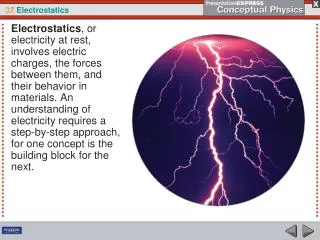
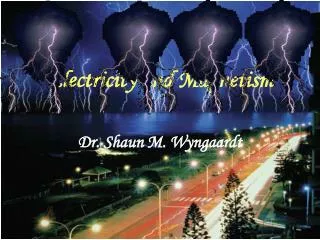
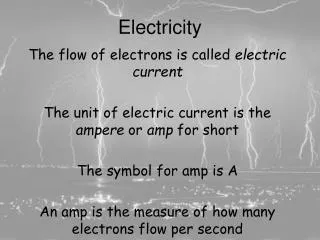
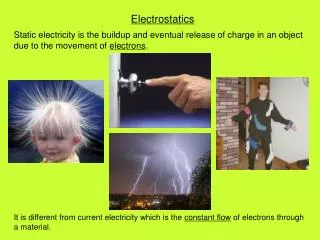
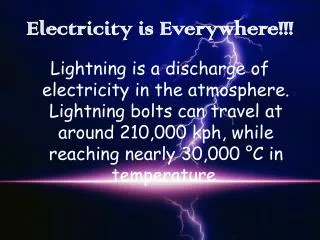
Electricity is Everywhere!!! Lightning is a discharge of electricity in the atmosphere. Lightning bolts can travel at around 210,000 kph, while reaching nearly 30,000 °C in temperature.
Science Today • What is electricity? • Wall experiment • Understanding electricity • Atoms, electrons, and protons • How does it work?
What is Electricity? • What would happen without electricity? • Why is electricity important? • When you think about electricity, what do you think about?
Try This: Using Electricity IMAGINE
Balloon • What will happen to the balloon the first time? • What will happen to the balloon the second time? • How can you explain what you observed?
To understand what electricity is, you have to know more about atoms.
All About Atoms • Atoms are the building blocks that make up everything around us. • Each atom contain small particles that have an electric charge.
Atoms • Particles in atoms can have a negativeor positive charge. • Negative charge=electron (-) • Positive charged=proton (+)
Why is it important to know about these positive and negative particles?
Back to the Balloon… • Why did the balloon stick to the wall? • What happens to make an object attract another object? • Think about the different charges within each object
How Do Electric Charges Work? • We can change the balance of electric charges in an object so that the charges are unequal (unbalanced). • When this happens, the objected is charged with electricity!
How It Works • A positively charged wool is attracted to a negatively charged balloon. • Can protons attract protons? • Can electrons attract electrons?