SlideServe
Menu
Préférences
© SlideServe · v2026

Converting Cro Protein into a Transcriptional Activator through Site-Directed Mutagenesis

beatrice-west avatar
18 diapositives · 294 Views · Nov 20, 2014

This study delves into the transformation of the Cro protein into a transcriptional activator by introducing four critical amino acid substitutions. Through site-directed mutagenesis, we created a chimera, Cro67, that displayed transcription activation abilities similar to the cI protein, challenging traditional views on Cro's repressive functions. We detail binding interactions with operator sequences and assess the in vitro transcription activity of Cro67, ultimately discussing the implications for protein engineering and gene regulation. Our findings pose intriguing questions about transcription mechanisms in eukaryotic cells.
Converting Cro Protein into a Transcriptional Activator through Site-Directed Mutagenesis - slide 1
01 / 18Converting Cro Protein into a Transcriptional Activator through Site-Directed Mutagenesis
1 / 17

Télécharger la présentation

Converting Cro Protein into a Transcriptional Activator through Site-Directed Mutagenesis
Une image / un lien ci-dessous est fourni (tel quel) pour télécharger la présentation

Politique de téléchargement : le contenu du site vous est fourni TEL QUEL pour votre information et votre usage personnel ; il ne peut être vendu, concédé sous licence ni partagé sur d’autres sites sans l’accord de son auteur.Le contenu vous est fourni TEL QUEL, pour votre information et votre usage personnel uniquement. Téléchargez la présentation en cliquant sur ce lien. Lors du téléchargement, si vous ne parvenez pas à télécharger une présentation, l’éditeur a peut-être supprimé le fichier de son serveur.Pendant le téléchargement, si vous ne parvenez pas à obtenir une présentation, le fichier a peut-être été supprimé par l’éditeur.

F I N

Plus de contenu associé

Transcription de la présentation
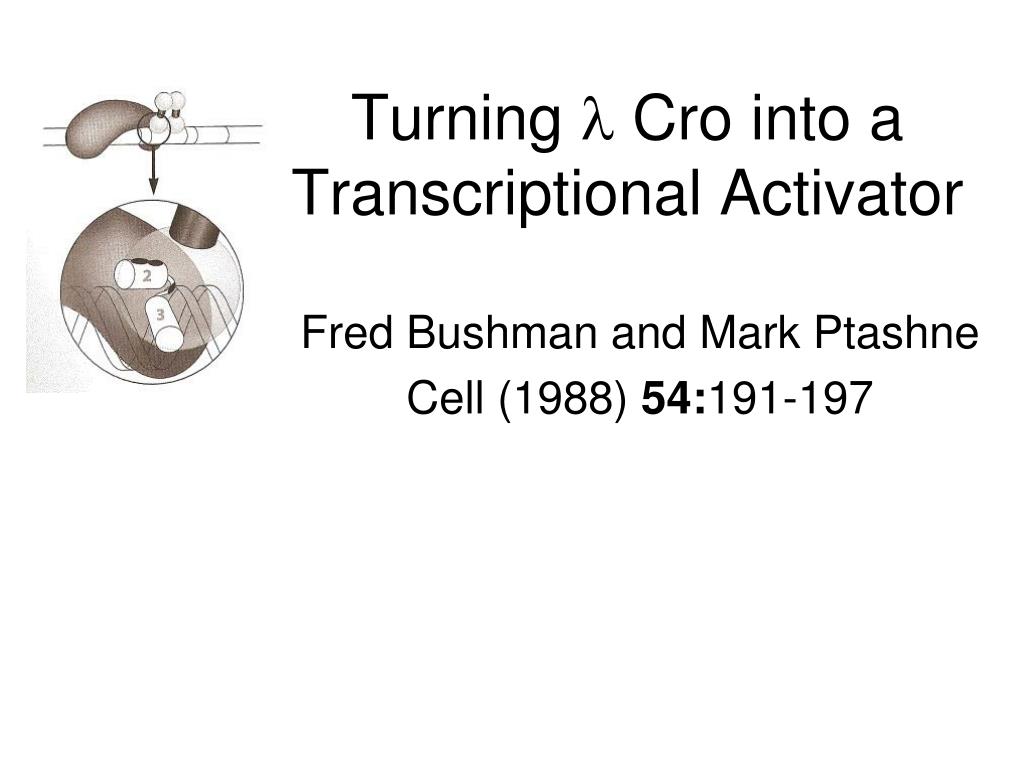
  1. Turning  Cro into a Transcriptional Activator Fred Bushman and Mark Ptashne Cell (1988) 54:191-197

  2. Small patch of acidic residues is necessary and sufficient for transcriptional activation Figure 1 cI normally activates transcription cro normally represses transcription cro/cI chimera activates transcription!

  3. Site-directed mutagenesis of cro helix to make acidic patch cartoon ofcI binding DNA Figure 2 Thr17 Lys21 Asp22 Tyr26 fig from “A Genetic Switch” 4 amino acid substitution --> “cro67”

  4. Why might this work?

  5. Site-directed mutagenesis of cro helix to make acidic patch Figure 2 Thr17 Lys21 Asp22 Tyr26 4 amino acid substitution --> “cro67”

  6. Site-directed mutagenesis of cro helix to make acidic patch Figure 2 Thr17 Lys21 Asp22 Tyr26 4 amino acid substitution --> “cro67”

  7. Site-directed mutagenesis of cro helix to make acidic patch Figure 2 Thr17 Lys21 Asp22 Tyr26 4 amino acid substitution --> “cro67”

  8. Site-directed mutagenesis of cro helix to make acidic patch Figure 2 Thr17 Lys21 Asp22 Tyr26 4 amino acid substitution --> “cro67”

  9. Protein -helix recognizes sequence in DNA major groove model of lac repressor binding lac operator http://www.bact.wisc.edu/Microtextbook/index.php?module=Book&func=displaychapter&chap_id=35&theme=printer

  10. Protein -helix recognizes sequence in DNA major groove • Wild type cro • binds OR3>>OR2 = OR1 • binding to OR3 shuts off tx’n from PRM • Wild type cI • binds OR1>OR2>OR3 • binding to OR2 activates tx’n from PRM

  11. OR1>OR2>OR3 Figure 3 Protein -helix recognizes sequence in DNA major groove • Wild type cro • binds OR3>>OR2 = OR1 • binding to OR3 shuts off tx’n from PRM • Wild type cI • binds OR1>OR2>OR3 • binding to OR2 activates tx’n from PRM • cro67 • binds? • activates?

  12. OR1=OR2>OR3 Figure 3 Protein -helix recognizes sequence in DNA major groove • Wild type cro • binds OR3>>OR2 = OR1 • binding to OR3 shuts off tx’n from PRM • Wild type cI • binds OR1>OR2>OR3 • binding to OR2 activates tx’n from PRM • cro67 • binds? • activates?

  13. 395 bases 250 bases cro67 activates transcription in vitro Figure 4 [cro67] 0 In vitro tx’n rxn’s + buffer + DNA w/ PRM + PR cro67 (purified) + 32P-ATP, CTP, GTP or UTP 37° 10’ then + RNAP 37° 10’ then +formamide to gel

  14. ~5x 395 bases ~5x 250 bases cro67 activates transcription in vitro Figure 4 cut out bands and count Observe: txn of PR as txn of PRM when cro67 added Q’s: What are extra bands? Is cro67 bound in natural way?

  15. OR1=OR2>OR3 cro67 binds operator sequences as expected Figure 4 [cro67] 0 DNase footprint + buffer + 32P-DNA w/ PRM + PR cro67 (purified) 37° 10’? then + DNase 37° 10’? then +formamide to gel? Observe: Q: is assay sensitive to different conformations of bound prot?

  16. cro67 activates transcription in vitro Supporting data/controls Figure 5 Wild type cro does not activate txn in vitro using in vitro txn rxn, DNase ftpt Figure 6 cro67 does not activate txn from other promoters cro67 in vivo exp’ts hampered by low affinity for operators (~100x < wt cro)

  17. Summary of 434 cI data ** in vivo (-gal assays on lysogen) **in vivo DMS ftpt ** in vitro txn rxns, DNase ftpt

  18. Turning cro into a transcriptional activator key assumption in vitro conclusions have meaning in vivo biggest mistake(s) mixing the 434 work in not pushing in vivo work significance/meta-lessons • protein engineering by analogy (cro is like cI, thus…) • small changes (e.g., individual AAs) are important • good data enables thoughtful experiments • be open to surprises (e.g., DNA binding) • ask the next question: does activation work the same way in eukaryotic cells?