Appearance Models for Graphics
This document provides a brief overview of reflection models used in computer graphics, discussing various BRDF representations such as microfacet (Torrance-Sparrow, Oren-Nayar) and phenomenological models (Koenderink and van Doorn). Key aspects include the properties of symmetry, reciprocity, and isotropy in BRDF representations, as well as the use of Zernike polynomials for efficient basis functions. The assignment details encourage students to prepare presentations on selected models and submit their rankings and project proposals for effective class participation.

Appearance Models for Graphics
E N D
Presentation Transcript
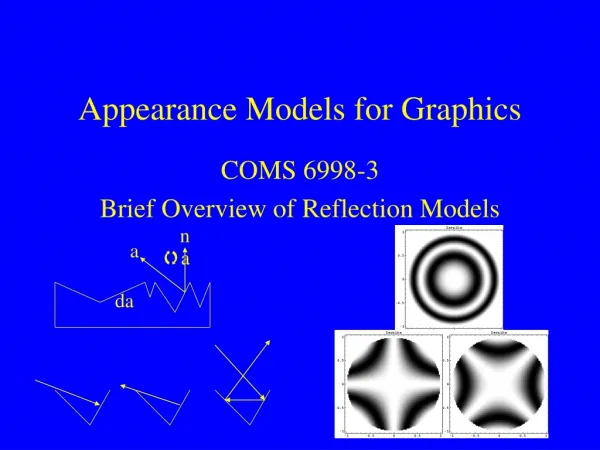
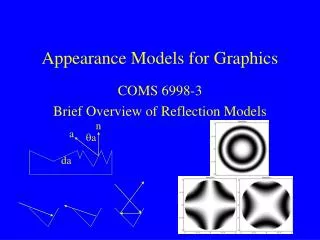
n a a da Appearance Models for Graphics COMS 6998-3 Brief Overview of Reflection Models
Assignments • E-mail me name, status, Grade/PF. If you don’t do this, you won’t be on class list. [and give me e-mails now] • Let me know if you don’t receive e-mail by tomorrow • E-mail me list of papers to present (rank 4 in descending order). Must receive by Fri or you might be randomly assigned. • Next week, e-mail brief descriptions of proposed projects. Think about this when picking papers
Today Appearance models • Physical/Structural (Microfacet: Torrance-Sparrow, Oren-Nayar) • Phenomenological (Koenderink van Doorn)
n a a da Masking Interreflection Shadowing dA Symmetric Microfacets Brdf of grooves simple: specular/Lambertian Torrance-Sparrow: Specular Grooves. Specular direction bisects (half-angle) incident, outgoing directions Oren-Nayar: Lambertian Grooves. Analysis more complicated. Lambertian plus a correction
Phenomenological BRDF model Koenderink and van Doorn • General compact representation • Domain is product of hemispheres • Same topology as unit disk, adapt basis • Zernike Polynomials
Paper presentations • Torrance-Sparrow (Kshitiz) • Oren-Nayar (Aner) • Koenderink van Doorn (me, briefly)
Phenomenological BRDF model Koenderink and van Doorn • General compact representation • Preserve reciprocity/isotropy if desired • Domain is product of hemispheres • Same topology as unit disk, adapt basis • Outline • Zernike Polynomials • Brdf Representation • Applications
Zernike Polynomials • Optics, complete orthogonal basis on unit disk using polynomials of radius • R has terms of degree at least m. Even or odd depending on m even or odd • Orthonormal, using measure dd n-|m| even |m|n Cool Demo: http://wyant.opt-sci.arizona.edu/zernikes/zernikes.htm
|m| 0 1 2 n |m| n |m| n 0 n-|m| must be even |m| n n-|m| must be even 1 n-|m| must be even n-|m| must be even 2
m>0:cos(m) m=0:sqrt(2) m<0:sin(m) azm= Hemispherical Zernike Basis • Measure Disk: Hemisphere: sin()dd • Set dd
BRDF representation • Reciprocity: aklmn=amnkl
BRDF representation • Reciprocity: aklmn=amnkl • Isotropy: Dep. only on = |i-r| Expand as a function series of form cos(m[i-r]) • Can define new isotropic functions • Symmetry (Reciprocity): alnm= anlm
BRDF Representation: Properties • First two terms in series • 5 terms to order 2,14 to order 4, 55 order 8 • Lambertian: First term only • Retroreflection: ln • Mirror Reflection: (-1)m ln • Very similar to Fourier Series alnm = l0 n0 m0 alnm = ln alnm = (-1)mln
Applications • Interpolating, Smoothing BRDFs • Fitting coarse BRDFs (e.g. CURET). Authors: Order 2 often sufficient • Extrapolation • Some BRDF models can be exactly represented (Lambertian, Opik) • Others to low order after filtering/truncation • High-order terms are typically noisy
Discussion/Analysis • Strong unified foundation • Spectral analysis interesting in own right • Ringing!! Must filter • Don’t handle BRDF features well • Specularity requires many terms • Theoretically superior to spherical harmonics but in practice?