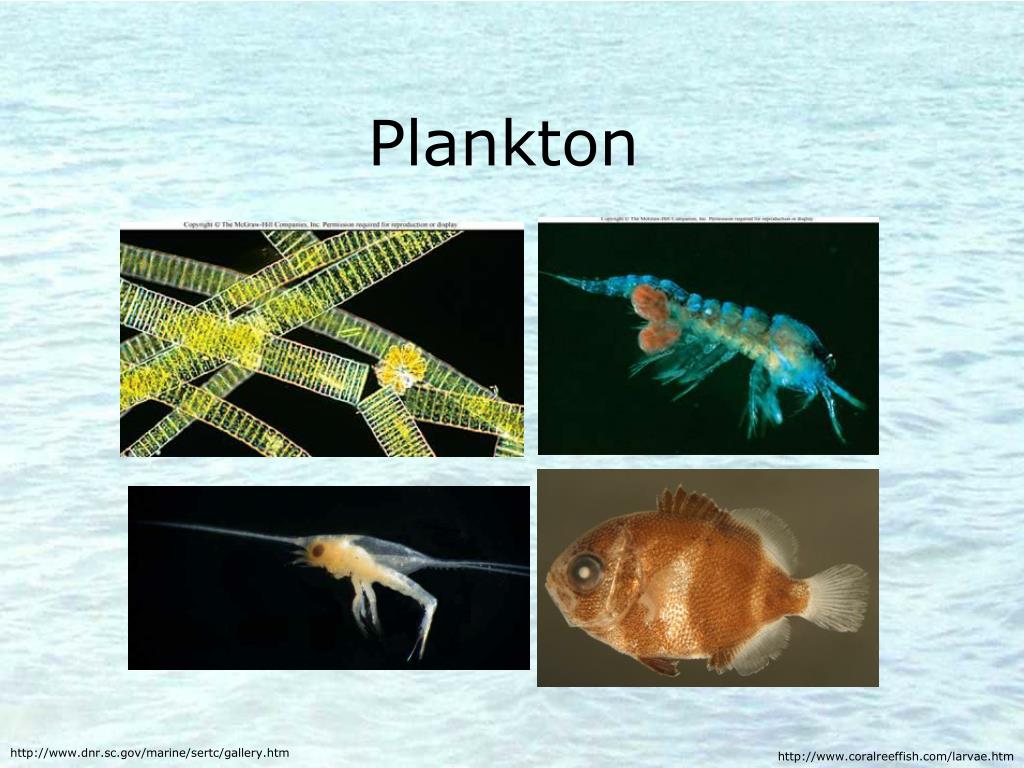
Plankton http://www.dnr.sc.gov/marine/sertc/gallery.htm http://www.coralreeffish.com/larvae.htm
Ocean Zones • Horizontal divisions: • Coastal (neritic) = on/over shelf (shallow) • Oceanic = beyond continental shelf (deep) • Vertical divisions: • Pelagic = open water • Benthic = ocean bottom
Ocean Zones
Plankton or Nekton? How fast can you swim? • Gulf Stream peak velocity • = 5 knots = 2.5 m/sec • Surface currents more typically • <0.5 knot = 0.25 m/sec (=0.56 mph) http://oceancurrents.rsmas.miami.edu/atlantic/img_mgsva/gulf-stream-YYY.gif
Plankton or Nekton? Swim faster than 25 cm/sec? Yes→ Nekton: • Dolphin = 170 cm/sec (up to 40 mph!) • Tuna = 75 cm/sec (higher burst speeds) No→ Plankton: • Shrimp = 5 cm/sec • Bacteria = 0.005 cm/sec
Slow, but not necessarily small Portuguese man-of-war float = 12 inches wide tentacles = over 150 ft. long (ouch!) http://www.dnr.sc.gov/marine/sertc/gallery.htm
Net Plankton
Phytoplankton • Cyanobacteria • Unicellular microalgae • Diatoms • Dinoflagellates • Coccolithophorids c2004 Pearson Education, Inc., publishing as Benjamin Cummings http://www.daviddarling.info/images/diatoms.jpg http://www.microscopy-uk.org.uk/micropolitan/fresh/protozoa/ceratiumdic2.jpg
Zooplankton • Protozoans (unicellular): • Foraminiferans • Radiolarians • Ciliates http://www.anu.edu.au/EMU/Images/radiol.jpg http://server1.fandm.edu/Departments/Biology/People/Shimeta/research/tin2.JPG
Zooplankton • Gelatinous: • Jellyfish (medusa) • Siphonophores NOAA http://life.bio.sunysb.edu/marinebio/plankton.html
Zooplankton • Gelatinous: • Comb jellies (ctenophores)
Zooplankton • Gelatinous: • Salps • Larvaceans (invertebrate chordates) NOAA
Zooplankton • Molluscs: • Pteropods (gastropods), with and without shell
Zooplankton • Crustaceans: • Copepods • Amphipods • Ostracods • Isopods • Krill, shrimp http://www.oceanexplorer.noaa.gov/gallery/livingocean/livingocean.html
Zooplankton • “Arrow worms” (Phylum Chaetognatha) http://pharyngula.org/images/chaetognathhead.jpg http://www.microscopy-uk.org.uk/mag/imgjan00/CHAET2b.JPG
Zooplankton • Mollusc larvae: • Trochophore • Veliger http://oceanlink.island.net/abaloneproject/growthanddevelopment/growth%20and%20development.htm http://people.bu.edu/veliger/
Zooplankton • Crustacean larvae: • Crab zoea • Shrimp, barnacle nauplius • Lobster phyllosoma NOAA http://www.dnr.sc.gov/marine/sertc/gallery.htm http://www.science-in-salamanca.tas.csiro.au/themes/larval/phyllosoma-early.htm
NOAA Zooplankton • Other larvae: • Starfish (bipinnaria) • Brittle stars, urchins (pluteus) http://raven.zoology.washington.edu/embryos/
Zooplankton • More larvae: • Polychaete worms (trochophore) http://www.microscopy-uk.org.uk/mag/imgmar99/poly3.jpg
Zooplankton • Fish larvae http://www.coralreeffish.com/larvae.htm
Zooplankton • Not all zooplankton are larvae • Those that are larvae, grow up to be nekton or benthic = meroplankton
Zooplankton • Not all zooplankton are larvae • Those that live whole lives as plankton = holoplankton http://www.oceanexplorer.noaa.gov/gallery/livingocean/livingocean.html
That Sinking Feeling • It’s a long way down – average ocean depth around 4000 m • Phytoplankton – need to stay in the light surface layer (0-200 m) • Zooplankton – eat the phytoplankton and/or other zooplankton, so need to be where the food is http://www.nerc.ac.uk/images/photos/lp-ocean-sunlight.jpg
That Sinking Feeling • Why am I sinking? Denser than water • Densities (in g/cm3): • Seawater = 1.025 • Air = 0.00125 • Lipids = 0.9 • Proteins = 1.3 • Carbohydrates = 1.5 • Cellulose = 1.5 • Silica shell = 2.6 • Calcareous shell = 2.8
That Sinking Feeling • How not to sink: • Float – • Lipids (less dense than water) • Gas vacuoles, sacs, bubbles http://www-cyanosite.bio.purdue.edu/images/images.html
NOAA That Sinking Feeling • How not to sink: • Stay neutral • High water content (gelatinous) • Reduced or no shell
That Sinking Feeling • How not to sink: • Drag (high surface area) – • Small size • Flat shape • Spines, long structures -------- Isopod
That Sinking Feeling • How not to sink: • Upwelling (also good for nutrients) Southern Hemisphere – Ekman transport to the left
That Sinking Feeling • How not to sink: • Actively swim – cilia, flagella, muscles, appendages http://www.coralreeffish.com/larvae.htm
Nowhere to Hide • Active predators can’t eat what they can’t see – so be invisible
Nowhere to Hide • Active predators can’t eat what they can’t see – so hide where it is dark
NOAA Somewhere to Hide • Floating mats of macroalgae and seagrasses form pelagic communities - camouflage Sargassum http://www.bigelow.org/bacteria/teach/images/open_orgs/sargassum.jpg http://www.naturalsciences.org/education/deepsea/images/sargassum_fish.jpg
Food Webs
Food Webs