Download
1 / 13
130 likes | 257 Vues
This overview explores the nature of heat as kinetic energy within substances. It explains that heat is the motion of molecules, not of the substance itself, and describes how heat flows between objects due to temperature differences. Key concepts include measuring heat in Celsius and Fahrenheit, understanding thermal equilibrium, and distinguishing between conductors and insulators. The section on expansion and contraction illustrates how temperature changes affect particle movement in solids, liquids, and gases. Additionally, it covers methods of heat transfer: conduction, convection, and radiation through practical examples.

E N D
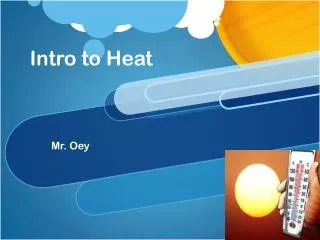
Intro to Heat Mr. Oey
Heat • Heat is kinetic energy in a substance. Heat is the motion of the molecules in a substance, not the motion of the substance itself. • Energy that flows between two objects because of a difference in temperature. For example, a metal spoon in hot water.
Measuring Heat Celsius Fahrenheit Freezing: 32 degrees Boiling: 212 degrees • Freezing: 0 degrees • Boiling: 100 degrees
Heat Movement • Molecules move from places of higher temperatures to places with lower temperatures
Thermal Equilibrium • Molecules move from warm to cold until they reach a balanced temperature • This balance is called thermal equilibrium.
Insulators & Conductors 6th Grade Science
Vocabulary Insulator Conductor an object that easily allows the transfer of energy • an object that reduces the transfer of heat
Vocabulary Solid • particles vibrate in one place Liquid • particles spin and move closely together Gas • particles spin and move fast and far away from each other
Vocabulary Expansion Contraction as molecules are cooled they move closer together and cause objects to shrink (contract) Cooling = Smaller • as molecules are heated they spread out as they move around quickly and cause objects to become larger (expand) • Heating = Bigger
Heat Transfer Kinetic Energy
Vocabulary Convection • Transfer of heat in liquids & gases • Heat rises Radiation • Transfer of heat in empty space w/o any particles Conduction • the transfer of heat by direct contact between solids
Examples Convection • Boiling water • Heating a home Radiation • Sun’s rays heating a car Conduction • A pot heating on a stove