SlideServe
Menu
Préférences
© SlideServe · v2026

Intro to

connie avatar
12 diapositives · 396 Views · Sep 01, 2012

Intro to. PARABOLAS. A parabola is formed by the intersection of a plane with a cone when the cone intersects parallel to the slant height of the cone. FOCUS. DIRECTRIX.
Intro to - slide 1
01 / 12Intro to
1 / 17

Télécharger la présentation

Intro to
Une image / un lien ci-dessous est fourni (tel quel) pour télécharger la présentation

Politique de téléchargement : le contenu du site vous est fourni TEL QUEL pour votre information et votre usage personnel ; il ne peut être vendu, concédé sous licence ni partagé sur d’autres sites sans l’accord de son auteur.Le contenu vous est fourni TEL QUEL, pour votre information et votre usage personnel uniquement. Téléchargez la présentation en cliquant sur ce lien. Lors du téléchargement, si vous ne parvenez pas à télécharger une présentation, l’éditeur a peut-être supprimé le fichier de son serveur.Pendant le téléchargement, si vous ne parvenez pas à obtenir une présentation, le fichier a peut-être été supprimé par l’éditeur.

F I N

Plus de contenu associé

Transcription de la présentation
  1. Intro to PARABOLAS

  2. A parabola is formed by the intersection of a plane with a cone when the cone intersects parallel to the slant height of the cone.

  3. FOCUS DIRECTRIX On a cartesian plane, the set of points that describe a parabola is defined using a point called the FOCUS and a line called the DIRECTRIX. The distance from the focus to the vertex or from the directrix to the vertex is ‘a’. This value plays a role in defining the equation of the parabola. The distance of a given point on the parabola from the focus is equal to the distance of that same point to the directrix. When that point is the vertex (the tip of the parabola) that distance has a special significance. It defines an important parameter for the parabola known as ‘a’.

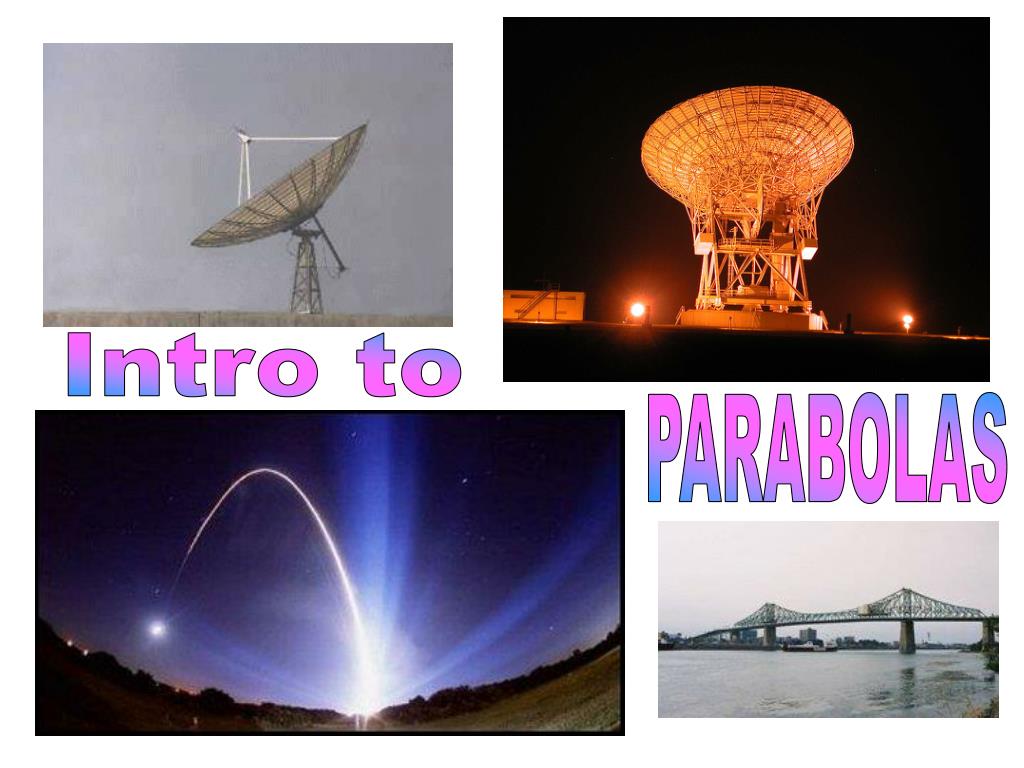
  4. Ball Parabolas are the shapes that define projectile motion (the path that a ball takes when it is hit or thrown into the air).

  5. Parabolas show up in the architecture of bridges.

  6. The parabolic shape is used when constructing mirrors for huge telescopes, satellite dishes and highly sensitive listening devices.

  7. focus If this parabola is a satellite dish or a telescopic mirror, the receiver is located at the focus. Parallel rays strike the parabola and all reflect to the focus If it is the reflective surface of a lamp, then the light-bulb is located at the focus of the mirror and the arrows point in the other direction.

  8. ‘a’ is positive ‘a’ is negative ‘a’ is negative ‘a’ is positive The equation for a parabola with a vertex at the origin can have one of two formats depending on whether it opens vertically or horizontally. y2 = 4ax x2 = 4ay

  9. To construct graphs of a parabola, we first must decide whether the parabola opens horizontally or vertically and that depends on the format of the equation: y2 = 4ax OR x2 = 4ay. Equation: y2 = 12x x2 = 20y Value of “a”: 4a = 12 a = 3 4a = 20 a = 5 Direction of Opening: Horizontal: Right Vertical: Up Vertex: V (0,0) V (0,0) Focus: F (3,0) F (0,5) Axis of Symmetry: s: y = 0 s: x = 0 Directrix: D: x = -3 D: y = -5

  10. D: x=-3 F (0,5) s: y = 0 V (0,0) F (3,0) V (0,0) D: y=-5 s: x=0 Other Points: If x = 3, Then y2 = 12(3) y2 = 36 y = 6 y = -6 (3,6) (3,-6) If y = 5, Then x2 = 20(5) x2 = 100 x = 10 x = -10 (10,5) (-10,5)

  11. y2 = -10x 4a = -10 a = -2.5 Opens left V(0,0) F(-2.5,0) s: y = 0 D: x = 2.5 Other Points If x = -2.5 then y2 = -10(-2.5) y2 = 25 y = 5 y = -5 (-2.5,5) (-2.5,-5)

  12. THE END