Transforming Education: From Compliance to Community in Student Learning
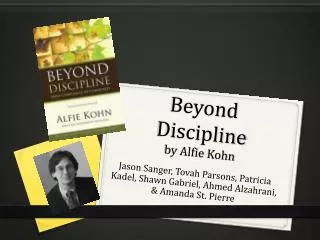
In "Beyond Discipline," Whittney Smith, Ed.D., explores the shift from traditional compliance-based education to a community-focused approach. The book delves into the essential assumptions that learning is intrinsically motivated and how reliance on rewards and punishments can undermine students' natural motivation. By fostering an environment that values choice, community, and shared responsibility, educators can empower students to take control of their own behavior and learning. The Pygmalion effect highlights the power of belief in student potential, illustrating how positive expectations can lead to remarkable achievements.

Transforming Education: From Compliance to Community in Student Learning
E N D
Presentation Transcript
Beyond Discipline From Compliance to Community Whittney Smith, Ed.D.
Assumptions • Learning is intrinsically motivated • Rewards and punishments reduce intrinsic motivation • Rewards produce temporary results
Premise • Students are responsible for their own behavior • Students are capable of controlling their own behavior • We need to work with children to encourage their social and moral development which means utilizing their need to… • be able to make their own decisions • belong • learn and apply learning
What we believe matters “Someone who thinks that kids are always trying to get away with something is likely to believe that we adults must overcome these unsavory motives, force children to obey rules, and see to it that they are punished when they don’t.” (Kohn p. 8)
Classroom • Content • Community • Choice
Classroom • Content • Community • Choice
Classroom • Content • Community • Choice
Do you Believe in Me? • Pygmalion effect • When teachers were led to believe that their students had extraordinary intellectual potential, these average students really did end up achieving impressively in their classes.