
SlideServe
Menu
Préférences
© SlideServe · v2026

Integrating Excel in AP Environmental Science: A Case Study of Loch Vale Watershed

benjy avatar
1 diapositives · 180 Views · Oct 04, 2014

This project empowers students in AP Environmental Science to utilize Excel for scientific inquiry by analyzing real-world data from the Loch Vale Watershed. Through hands-on activities such as graphing, filtering, and constructing formulas in Excel, students learn to interpret ecological data, communicate findings, and engage in discussions about environmental issues linked to human impact. The field trip to Rocky Mountain National Park provides practical experience while furthering their understanding of scientific methods, ecological research, and environmental stewardship.
Integrating Excel in AP Environmental Science: A Case Study of Loch Vale Watershed - slide 1
01 / 1Integrating Excel in AP Environmental Science: A Case Study of Loch Vale Watershed
1 / 17

Télécharger la présentation

Integrating Excel in AP Environmental Science: A Case Study of Loch Vale Watershed
Une image / un lien ci-dessous est fourni (tel quel) pour télécharger la présentation

Politique de téléchargement : le contenu du site vous est fourni TEL QUEL pour votre information et votre usage personnel ; il ne peut être vendu, concédé sous licence ni partagé sur d’autres sites sans l’accord de son auteur.Le contenu vous est fourni TEL QUEL, pour votre information et votre usage personnel uniquement. Téléchargez la présentation en cliquant sur ce lien. Lors du téléchargement, si vous ne parvenez pas à télécharger une présentation, l’éditeur a peut-être supprimé le fichier de son serveur.Pendant le téléchargement, si vous ne parvenez pas à obtenir une présentation, le fichier a peut-être été supprimé par l’éditeur.

F I N

Plus de contenu associé

Transcription de la présentation
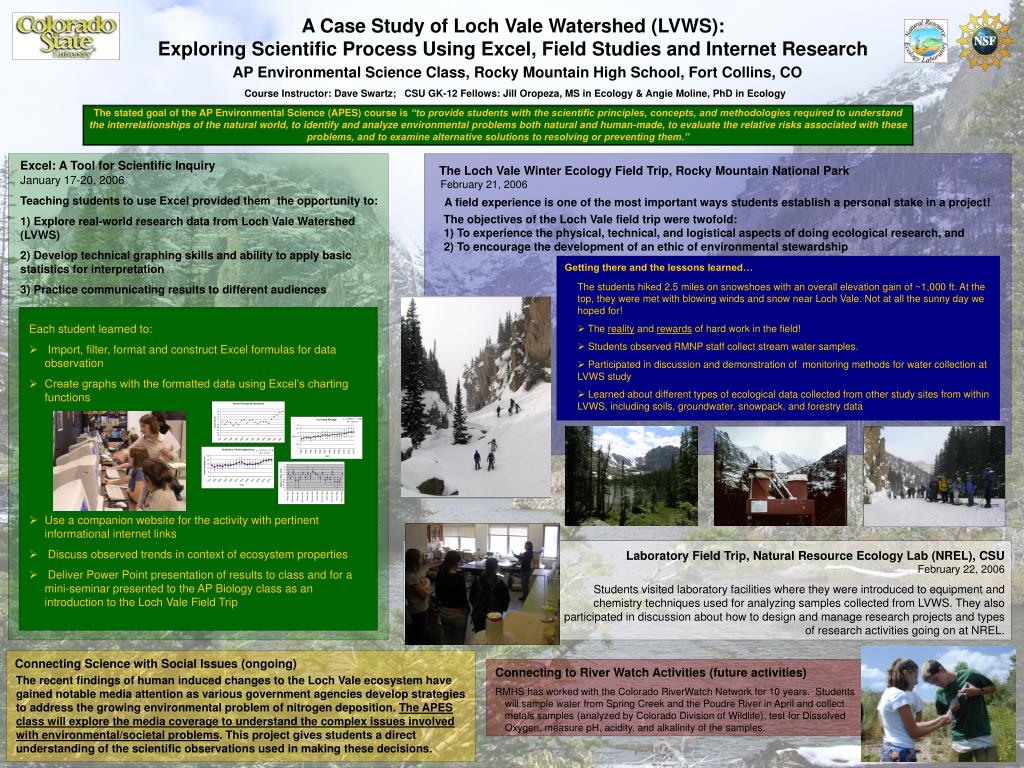
  1. Each student learned to: • Import, filter, format and construct Excel formulas for data observation • Create graphs with the formatted data using Excel’s charting functions • Use a companion website for the activity with pertinent informational internet links • Discuss observed trends in context of ecosystem properties • Deliver Power Point presentation of results to class and for a mini-seminar presented to the AP Biology class as an introduction to the Loch Vale Field Trip Connecting Science with Social Issues (ongoing) The recent findings of human induced changes to the Loch Vale ecosystem have gained notable media attention as various government agencies develop strategies to address the growing environmental problem of nitrogen deposition. The APES class will explore the media coverage to understand the complex issues involved with environmental/societal problems. This project gives students a direct understanding of the scientific observations used in making these decisions. A Case Study of Loch Vale Watershed (LVWS): Exploring Scientific Process Using Excel, Field Studies and Internet Research AP Environmental Science Class, Rocky Mountain High School, Fort Collins, CO Course Instructor: Dave Swartz; CSU GK-12 Fellows: Jill Oropeza, MS in Ecology & Angie Moline, PhD in Ecology The stated goal of the AP Environmental Science (APES) course is “to provide students with the scientific principles, concepts, and methodologies required to understand the interrelationships of the natural world, to identify and analyze environmental problems both natural and human-made, to evaluate the relative risks associated with these problems, and to examine alternative solutions to resolving or preventing them.” Excel: A Tool for Scientific Inquiry January 17-20, 2006 Teaching students to use Excel provided them the opportunity to: • Explore real-world research data from Loch Vale Watershed (LVWS) • Develop technical graphing skills and ability to apply basic statistics for interpretation • Practice communicating results to different audiences The Loch Vale Winter Ecology Field Trip, Rocky Mountain National ParkFebruary 21, 2006 A field experience is one of the most important ways students establish a personal stake in a project! The objectives of the Loch Vale field trip were twofold: 1) To experience the physical, technical, and logistical aspects of doing ecological research, and 2) To encourage the development of an ethic of environmental stewardship Getting there and the lessons learned… • The students hiked 2.5 miles on snowshoes with an overall elevation gain of ~1,000 ft. At the top, they were met with blowing winds and snow near Loch Vale. Not at all the sunny day we hoped for! • The reality and rewards of hard work in the field! • Students observed RMNP staff collect stream water samples. • Participated in discussion and demonstration of monitoring methods for water collection at LVWS study • Learned about different types of ecological data collected from other study sites from within LVWS, including soils, groundwater, snowpack, and forestry data Laboratory Field Trip, Natural Resource Ecology Lab (NREL), CSU February 22, 2006 Students visited laboratory facilities where they were introduced to equipment and chemistry techniques used for analyzing samples collected from LVWS. They also participated in discussion about how to design and manage research projects and types of research activities going on at NREL. Connecting to River Watch Activities (future activities) RMHS has worked with the Colorado RiverWatch Network for 10 years. Students will sample water from Spring Creek and the Poudre River in April and collect metals samples (analyzed by Colorado Division of Wildlife), test for Dissolved Oxygen, measure pH, acidity, and alkalinity of the samples.