Assessing the Digital Divide: Connectivity and Performance in Developing Regions
This presentation discusses the digital divide's impact on connectivity and performance for High Energy Nuclear Physics (HENP) collaborators, with an emphasis on inter-regional connectivity in developing countries. It highlights the Electronic Journal Distribution Service (eJDS) and its members, including countries like Egypt, India, and Brazil. Recommendations include real-time monitoring of research institutions' connectivity and resource development. The presentation advocates for continued efforts in performance monitoring through initiatives like PingER and exploring further collaboration among communities.

Assessing the Digital Divide: Connectivity and Performance in Developing Regions
E N D
Presentation Transcript
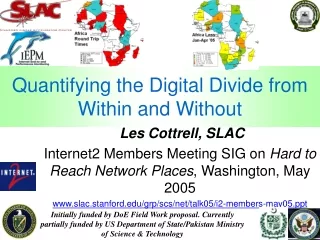
Quantifying the Digital Divide Warren Matthews, Les Cottrell (SLAC), Enrique Cannessa, Hilda Cerdeira (ICTP/eJDS). Presented at the Internet2 Spring Members Meeting, Arlington, VA, April 9-11, 2003.
Motivation • Interested in connectivity and performance to HENP Collaborators • Inter-regional connectivity • ICTP • Performance to eJDS subscribers
What is the eJDS ? • The Electronic Journal Distribution Service • Participating Members • Egypt, Bangladesh, Brazil, Guatemala, India, Indonesia, Iran, Jordon, Mexico, Pakistan
Recommendations of Trieste • To devote resources to monitor in real time the connectivity of research and educational institutions in developing countries and to encourage (and devote resources to) the development of the connectivity.
The View from SLAC • PingER • Performance monitoring • Resource allocation • Troubleshooting • The benefit of a connection
Further Work • Monitoring from ICTP • More targets • Other communities • Monitor transitions • Further Analysis • Possible workshop in Trieste in November
This is a BOF • Monitoring is essential to engineering • If you don’t measure, you don’t know (I.e. what I can do for you) • If you are measuring, share (I.e. what can you do for me) • Interested ? • Indianapolis ?