Quantifying the Digital Divide
This document explores the challenges and trends in bridging the digital divide between developed and developing countries. Funded partially by the DOE/MICS, it reports on improvements and ongoing issues in internet performance across different regions, highlighting critical areas such as Central Asia, Africa, and South Asia that continue to lag. The findings stem from a 2003 round table discussion among various stakeholders aimed at enhancing access to scientific knowledge and technology in developing nations. Collaborative efforts and strategic alternatives are proposed to empower scientists in remote areas.

Quantifying the Digital Divide
E N D
Presentation Transcript
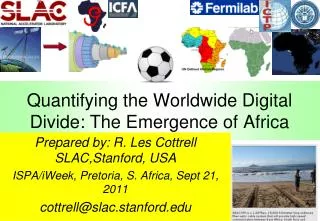
Quantifying the Digital Divide Les Cottrell – SLAC Prepared for the ICFA-SCIC video meeting, May 2003 http://www.slac.stanford.edu/grp/scs/net/talk/icfa-may03.html Partially funded by DOE/MICS Field Work Proposal on Internet End-to-end Performance Monitoring (IEPM), by the SciDAC base program.
Coverage • Added about 10 new countries for eJDS/ICTP, including W. Africa, Saudi Arabia, Jordan, Bangladesh, Vietnam, Guatemala, Nigeria, Ghana • Hosts in over 70 countries monitored • Need contacts for: Peru, Ecuador, Morocco, Algeria, Libya, Tunisia, Mauritania, Senegal, Cameroon, Syria, Oman, Nicaragua, Honduras, Belize, Phillipines
Current State Worst regions (by loss): Central Asia, Africa, South Asia, and Middle East (except Israel) For more details see: http://arxiv.org/ftp/physics/papers/0305/0305016.pdf
Trends by region 80% improvement Factor 10 in 4 yrs • Latin America and S. E. Europe catching up • China, Russia & Indian sub-continent keeping up but many years behind • Africa falling further behind • Performance from California to developing regions is hundreds of times worse than to developed regions
Second Open RoundTableon Developing Countries Access to Scientific Knowledge: Quantifying the Digital Divide • 23-24 October 2003, Trieste, Italy • By invitation • Open round table among scientists, librarians, decision-makers, journalists, electronic publishers, contents providers, information and communication technology experts, donors and non-profit organizations working on the dissemination of science and the transfer of knowledge and technology towards developing countries. • Goal bring together all interested parties to analyse, share experiences, promote ideas and discuss • better understanding and quantifying the digital divide (for example, differences in network performance for developed and developing countries) • concrete strategic alternatives • innovative technological tools • e-contents licensing issues • to support scientists working in remote areas and having low-bandwidth, or expensive access to on-line database services and the Internet. • International Advisory Committee • Minella Alarcon (UNESCO) • Les Cottrell (SLAC) • Harvey B Newman (Caltech) • Carol Priestley (INASP • Web page: http://www.ejds.org/meeting2003/