Download

1 / 9
90 likes | 213 Vues
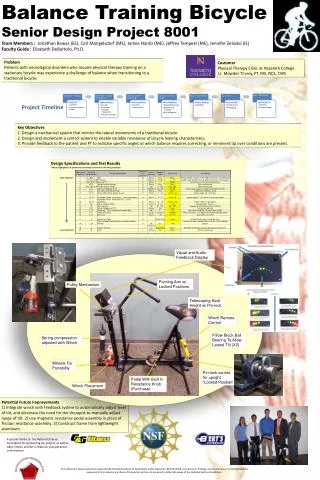
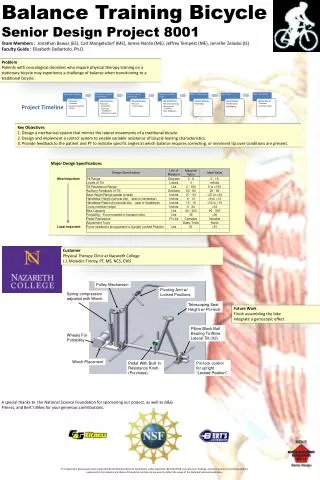
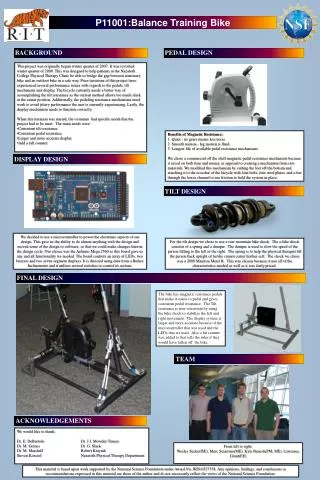
This project presents a novel stationary bicycle designed to bridge the gap between conventional and stationary bikes, specifically for balance training in recovering patients from strokes and neurological disorders at Nazareth College Physical Therapy Clinic. The design features a pulley mechanism, pivoting arm, adjustable seat height, and a comprehensive feedback system with audio and visual indicators to assist users in maintaining balance. The project is on budget and schedule, aiming to enhance patient rehabilitation through improved physical activity and balance control.

E N D
Stationary Balance Training Bicycle - P08001 • Team Members: • Jennifer Zelasko - IE • Carl Mangelsdorf - ME • Jeff Tempest - ME • James Nardo – ME • Jonathan Bawas – EE Sponsored by The National Science Foundation under Award No. BES-0527358
Project Description • Customer: Nazareth College Physical Therapy Clinic • Safe intermediate step between a stationary and traditional bicycle • Balance training for recovering physical therapy patients • Stroke • Neurological disorders
Concept Overview Pulley Mechanism Pivoting Arm w/ Locked Positions Spring compression adjusted with Winch Telescoping Seat Height w/ Pin-lock Pillow Block Ball Bearing To Allow Lateral Tilt (X2) Wheels For Portability Pin-lock control for upright “Locked Position” Friction Resistance Pedals
Concept Overview - Feedback • Audio / Visual Display Concept • Visual Feedback • LED Bank – indicating direction and level of tilt • Color Code • Green – normal tilt range • Yellow – region to correct balance • Red – Tip-over condition imminent • Audio Feedback • 2 Buzzers provides audio feedback • Auditory indication occur at yellow and red warning levels • Two tones • Slow Pulsed tone for “yellow” level • Fast pulse tone for “Red” Level
Final Design Summary • Leg brace supports: keep self aligning bearings perpendicular to axle • Handlebar adjustments: rotation at T-connection not necessary to achieve design specs • Feedback system: buffer used in place of comparator to simplify adjustments
Testing Results • Design meets all customer needs • Analysis of design meets engineering specifications for full system and subsystems • However, execution of our current test plan may reveal unforeseeable complications • Tilt range specification is overestimated, final calibration will refine final tilt range • Budget Considerations: • On target to meet project budget of $2000 • Current Total Cost of Parts = $1,717.14 • $282.86 left forshipping and small miscellaneous items • Schedule: on target • All key components are in stock with our selected suppliers with short lead times. • Items that require additional testing will be ordered week 11. (Inclinometer)
Objective Project Evaluation • Successes: • Failures: