
SlideServe
Menu
Préférences
© SlideServe · v2026

Hackman & Oldham’s Job Characteristics Model

bernad avatar
13 diapositives · 2.9K Views · Aug 26, 2011

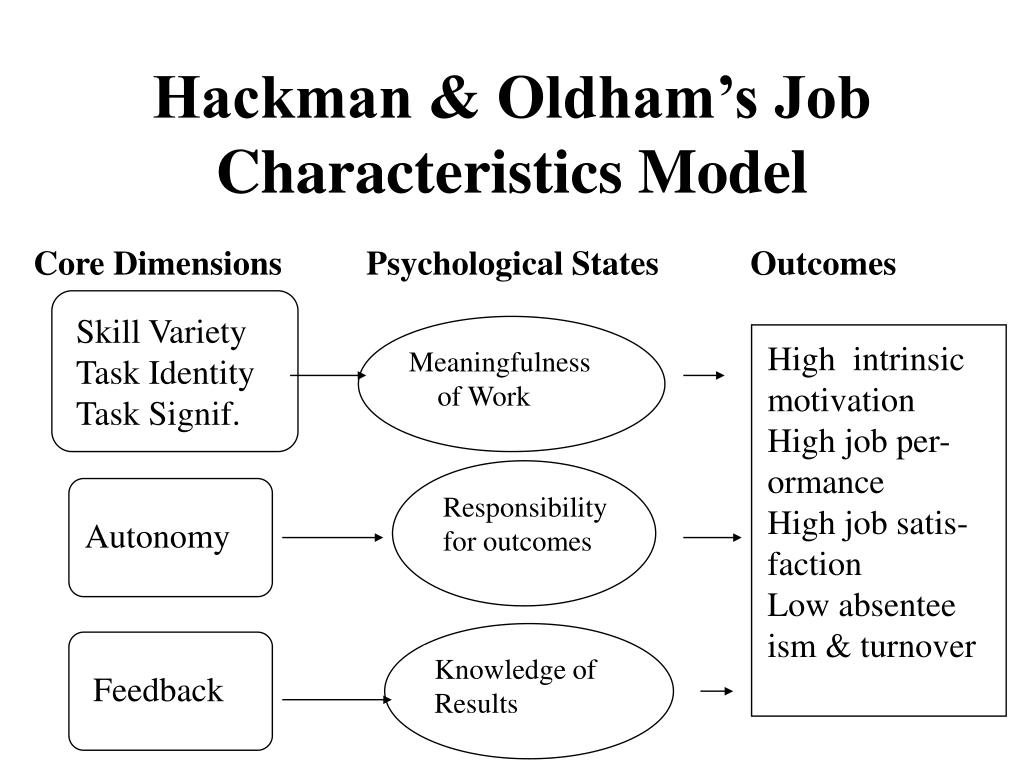
Hackman & Oldham’s Job Characteristics Model. Core Dimensions. Psychological States. Outcomes. Skill Variety Task Identity Task Signif. High intrinsic motivation High job per- ormance High job satis- faction Low absentee ism & turnover. Meaningfulness of Work. Responsibility
Hackman & Oldham’s Job Characteristics Model - slide 1
01 / 13Hackman & Oldham’s Job Characteristics Model
1 / 17

Télécharger la présentation

Hackman & Oldham’s Job Characteristics Model
Une image / un lien ci-dessous est fourni (tel quel) pour télécharger la présentation

Politique de téléchargement : le contenu du site vous est fourni TEL QUEL pour votre information et votre usage personnel ; il ne peut être vendu, concédé sous licence ni partagé sur d’autres sites sans l’accord de son auteur.Le contenu vous est fourni TEL QUEL, pour votre information et votre usage personnel uniquement. Téléchargez la présentation en cliquant sur ce lien. Lors du téléchargement, si vous ne parvenez pas à télécharger une présentation, l’éditeur a peut-être supprimé le fichier de son serveur.Pendant le téléchargement, si vous ne parvenez pas à obtenir une présentation, le fichier a peut-être été supprimé par l’éditeur.

F I N

Plus de contenu associé

Transcription de la présentation
  1. Hackman & Oldham’s Job Characteristics Model Core Dimensions Psychological States Outcomes Skill Variety Task Identity Task Signif. High intrinsic motivation High job per- ormance High job satis- faction Low absentee ism & turnover Meaningfulness of Work Responsibility for outcomes Autonomy Knowledge of Results Feedback

  2. Moderating Variables for the Job Characteristics Model • Growth need strength • job is a vehicle for personal growth, sense of achievement, avenue for feeling success • Knowledge and skills • Satisfaction with extrinsic aspects of work

  3. Motivating Potential Score Skill Variety +Task Identity+Task Significance 3 MPS = X Autonomy X Feedback

  4. Implementing Concepts for the Job Characteristics Model • Combine tasks: Effects skill variety, task identity, & task significance • Group tasks into natural work units: Effects task significance and task identity • Give workers contact with customers: Effects skill variety, autonomy, feedback • Vertically load jobs: Effects autonomy • Open feedback channels: Effects feedback

  5. Designing Jobs for Teams • Team has to be an identifiable group, doing a specified piece of work, and be self-managing • Key behaviors: Ask for ideas, give suggestions,. listen to others, share information, help others • Manager’s role: Make alterations needed for effective group performance, consult

  6. Goals That Motivate • Specific Goals • Difficult Goals • Goal Acceptance • Goal Feedback

  7. Why Goals Motivate • Mobilize energy in relation to goal • Focus attention towards goals attainment • Encourages setting of action plans or strategies for goal attainment • Encourages persistence until goal is attained

  8. Enhancing Goal Acceptance • Participation • Rewards • Supportiveness

  9. Incentives for Individuals • For Executives • Compensation tied to achieving strategic goals • For Lower Level Employees • Tied to performance: bonuses, commissions, piecework

  10. Incentives for Groups • Team incentives • Profit sharing • Gain sharing • Stock options

  11. Where Pay Fails to Motivate • Bonuses or merit pay is too small • Non-existent link between pay and performance • Performance appraisal is done poorly • Effect of unions • Adaptation problems

  12. Effective Reward Systems • Set high goals for performance • Develop accurate ways to measure performance • Train supervisors in performance appraisal • Link pay to performance • Make increases noticeable and meaningful

  13. Backwards & Forwards • Summing up: Examined how Hackman’s & Oldhams Job characteristics Model can be used to redesign jobs to engage motivation; studied how and why goals setting works & looked at ways to use pay as a motivator • Next time we begin our study of groups in the organization looking at how they function and the role of cohesiveness