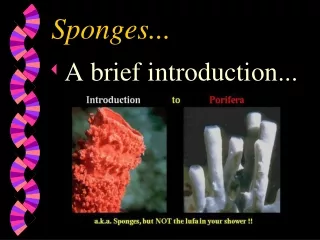
Understanding Sponges: Classification, Structure, and Reproduction
Sponges, belonging to the Kingdom Animalia and Phylum Porifera, are unique organisms characterized by their sessile lifestyle and asymmetrical structure. They lack specialized tissues or organs, forming a vase-like body with a hollow tube where water circulates through pores for respiration and feeding. Their specialized cells, choanocytes, and amebocytes play key roles in water movement and nutrient distribution. Sponges reproduce both asexually through budding and regeneration, and sexually by transferring sperm via amebocytes. With around 8,000 known species, sponges exhibit incredible diversity in habitat, size, and color.


Understanding Sponges: Classification, Structure, and Reproduction
E N D
Presentation Transcript
Sponges Discussion April 26, 2011
Classification • Kingdom – Animalia • Phylum – Porifera
Basic Characteristics • Sessile – do not move • No specialized tissues or organs • Asymmetrical
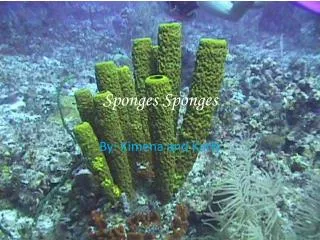
4. Body Structure • Vase-like wall around a hollow tube – closed at bottom and open at top • Water comes through pores (porocytes) on side and leaves through osculum at top - important for respiration, getting food and getting rid of wastes
4. Body Structure (cont.) • Have specialized cells called choanocytes (AKA collar cells) that move water through and trap food • Have specialized cells (amebocytes) that move carrying food and removing wastes • Structure – made of spongin (protein fibers) and spicules (needlelike structures)
5. Reproduction • Asexual – budding (part of existing fragment), regeneration (pieces growing into new sponges) • Sexual – sperm released, go into pores of another sponge, amebocytes transfer sperm to egg • New zygote develops flagella and swims away • Grows on new surface
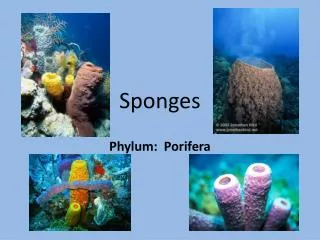
6. Diversity • Very old • 8000 know species • 3% in freshwater • Very diverse in where they live (depth), size and color • Classified by what they are made of (type of cells)