DO NOW
170 likes | 299 Vues
In our reading lesson, we focus on the importance of context clues to decipher unknown words. You'll enter the classroom quietly, place your homework on your desk, and begin with a "Do Now" activity. As we explore over 200,000 words in the English language, we’ll learn how to use surrounding sentences and hints to grasp meanings. Engage in practice exercises to identify and understand new vocabulary through context. Together, we can enhance our reading comprehension skills and empower ourselves to tackle confusing texts confidently.


DO NOW
E N D
Presentation Transcript
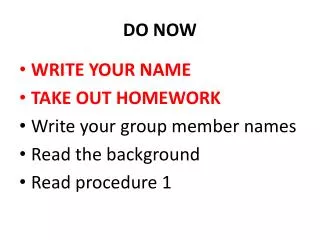
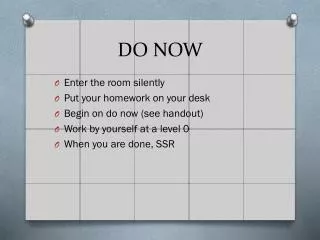
DO NOW • Enter the room silently • Put your homework on your desk • Begin on do now (see handout) • Work by yourself at a level 0 • When you are done, SSR
Have you ever been reading something a came across a word you did not know? How did you feel? What did you do?
There are over 200,000 (two-hundred thousand) words in the English language • Do you know ALL of them? • Nobody knows every single word they read • It’s okay!
What can we do? • Provisions, such as hot dogs and french fries, are delicious! • Provisions = ? • Provisions = food • HOW did we figure that out?
Context Clues • One of the best ways to identify unknown words is to use context clues • Context clues are words or sentences around unknown words that help you identify the meaning of the unknown word
To use context clues you should: • 1) Carefully read the words and sentences around the unknown word • CIRCLE the unknown word • Highlight the hints around the unknown word • 2) Thinkabout what is happening in the sentence around the unknown word • 3) Make a goodguess, based on what is happening, for what the word means • 4) Replacethe unknown word with your guess. If it makes sense, then it is correct!
Let’s try! • Owls are nocturnal. Instead of sleeping at night, they sleep in the morning and fly around and look for food at night. • Sally had to repress he anger so that she didn’t blow up in the middle of class when the teacher issued her demerits. • Keith must have been immune to the sickness. All his friends got sick, but he didn’t.
MOW Practice • In teams, find the unknown word (see correct page). Circle it. • Using context clues, find the answer choice that has the closest meaningto the unknown word. • Write your answer on the white board. • DO NOT let other teams see your answer! • Be prepared to explain WHY you chose your answer.
Fled (pg. 1) • To rebuild • To escape • To go back to • To burn down
Frolicked (pg. 2) • To clean • To hide • To play • To sit
Bewildered (pg. 3) • Confused • Happy • Tired • Prepared
Seething (pg. 4) • Sweating • Scared • Angry • Hungry
Demolished (pg. 8) • Beautiful • Old • Destroyed • Closed
Feeble (pg. 18) • Scared • Weak • Courageous • Japanese
Deliberately (pg. 19) • By accident • With anger • With joy • On purpose
Evacuating (pg. 21) • To leave or remove • To bring back • To carry • To feed