Protein Structure 2
This guide explores the hierarchy of protein structure, detailing the primary, secondary, tertiary, and quaternary levels. Learn about the significance of amino acid sequences, recurring structural motifs, and supersecondary structures like alpha-fibrous proteins and beta sheets. Discover how domains serve distinct functions within tertiary structures, alongside examples of structural motifs such as DNA binding and kinase phosphorylation. This comprehensive overview provides essential insights into protein folding and its implications in molecular biology.

Protein Structure 2
E N D
Presentation Transcript
Protein Structure 2 Higher Order Protein Structures
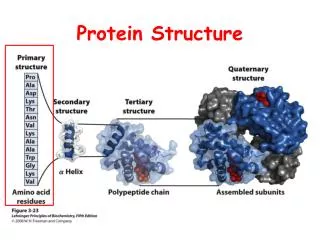
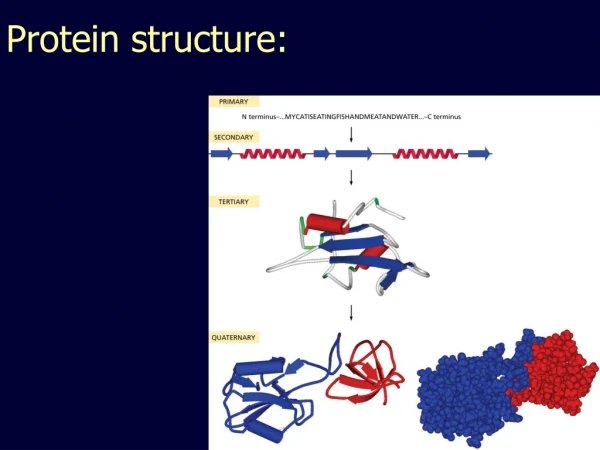
Hierarchy of Protein Structure Primary sequence- The amino acid sequence of a polypeptide, listed from N-terminus to C-terminus. Secondary structure- Recurring structural feature of proteins stabilized exclusively by hydrogen bonds between peptide bond elements. Supersecondary structure- Recurring structural feature of proteins composed of two or more secondary structural elements. Domain- A segment of protein structure that is autonomously stable. Tertiary structure- A stable, independent protein encoded by a single gene. Quaternary structure- A complex structure composed of two or more tertiary structure subunits.
Alpha-fibrous proteins: Coiled-coil Helix Supersecondary Structure Heptad repeats in GCN4 Four-helical bundle
Sequence Comparison Reveals Positional Preference Within Heptad Repeats
Parallel and Anti-parallel Beta Sheets anti-parallel parallel
Supersecondary Structures Structure of -grasp fold of ubiquitin showing motif Repeating motifs (n=7) form a Rossmann fold structure
Supersecondary Structures Greek key motif Beta meander motif
Domains and Tertiary Structure Domains- Structurally autologous structures possessing discrete functions that comprises part of the tertiary structure (beads on a string). Domains can be identified by their characteristic sequences. Ex: DNA binding domains, NAD+/NADP+ binding domains, HECT domains, Zn finger domains, etc. Motif- A highly conserved, short amino acid sequence that identifies a discrete function. Ex: Protein kinase phosphorylation motifs, Ca++ binding motifs, etc. Pyruvate kinase domain structure