Demystifying Chemical Bonding: Valence Electrons and Bonding Types
Explore the basics of chemical bonding, from valence electrons to different bonding types (ionic, covalent, metallic) and understanding stable vs. unstable atoms. Learn how to draw Lewis Dot Diagrams and identify valence electrons easily.


Demystifying Chemical Bonding: Valence Electrons and Bonding Types
E N D
Presentation Transcript
Chemical Bonding To bond or not to bond that is the question?
The Bohr model…but simpler • The Lewis Dot Structure is a simplified way to show the arrangement of valence electrons • Valence Electrons are electrons in the outer shell and determine the atom’s chemical properties (whether it will bond or not) • Valence electrons are located in the outer/last shell
How to determine the number of VE • Look at the group the element is located in to determine how many valence electrons an element gets • Transition Metals (groups 3-12) only have 2 valence electrons • When looking at groups 13-18, just look at the number after the “1” and that’s the number of VE
How to draw a Lewis Dot Diagram • Write the atomic symbol • Identify the number of valence electrons (look at the group #) • Using clockwise order, draw each valence electron around the element symbol. • There are only four spaces around the element and each space can only hold a maximum of 2 electrons
Let’s try one together…Argon • Remember the maximum electrons each shell can hold. Ar
Chemical Bond • An interaction (joining together) that holds two or more atoms or ions together to form new substances with different properties • The goal of atoms bonding is to get a complete or full outermost shell. This is called an Octet
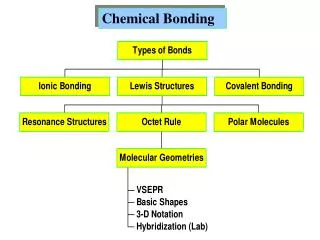
Types of Bonds • Ionic Bond – bonds that forms when electrons are transferred from one atom to another (electrons gained or lost) • Ions are positive and negative charged particles that form when atoms gain or lose electrons • Covalent Bond – bonds formed when atoms share one or more pair of electrons • Metallic Bond – chemical (covalent) bonding that results from the attraction between metal atoms and electrons
Stable or Unstable • Stable – non reactive (does not want to bond) Full outer shell • Unstable – Reactive (wants to bond) (outer most shell not full)