Enhancing Community Narratives through Mobile Technology: The Street Stories Initiative
110 likes | 223 Vues
The Street Stories project aims to transform community engagement by leveraging mobile technology to share local narratives. This initiative highlights the limitations of early implementations, comparing platforms like iPAQ and cell phones, particularly focusing on the BREW development environment for phones. The project demonstrates how GPS-enabled devices can deliver audio stories to users, enriching their connection to neighborhoods. It seeks to build stronger communities by exposing the history and culture through shared narratives, with an eye on future advancements in mobile storytelling.


Enhancing Community Narratives through Mobile Technology: The Street Stories Initiative
E N D
Presentation Transcript
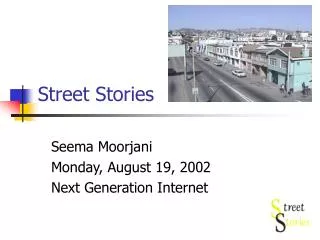
Street Stories Seema Moorjani Monday, August 19, 2002 Next Generation Internet
Outline • Introduction • Limitations of Initial Implementation • Possible Platforms: iPAQ vs. Cell Phone • BREW: Cell Phone Developing Environment • Design Needs for Cell Phone Platform • Demonstration • How it Works • Future Work
Introduction • What is Street Stories? • SIMS Project Professor Sack, Craig Rixford, Mahad Ibrahim http://dream.sims.berkeley.edu/street-stories/ Spring 2001 • Complex Community Narratives • Build stronger, more connected communities and expose the culture and history of neighborhoods through narratives • What portable device to use?
Limitations of Initial Implementation • Expensive, heavy equipment • Limited storage for audio on device • Lack of scalability (multiple devices) • Small amount of people have platform (currently)
Possible Platforms: iPAQ vs. Cell Phone • Only 2 million iPAQs sold since debut in 2000 (CNet News.com) • In 2000, about 400 cell phones for every 1,000 people in the U.S. (http://home.intekom.com/cellular) • By end of 2006, 240 million Location-Based Services capable handsets worldwide (Qualcomm, Inc.)
BREW: Cell Phone Developing Environment • Binary Runtime Environment for Wireless • Extensible API platform • Users customize handsets by wirelessly downloading applications they want (by connecting to BDS)
Design Needs for Cell Phone Platform • Server with database of audio files • Create a client on BREW-enabled phone to communicate with server • Appropriate files need to be downloaded from server and then played back
Demonstration • Demonstration of Mobile Street Stories
How it Works (1 of 2) • BREW-enabled phone sends GPS information to Apache server • Server queries MySQL DB for audio files within current region
How it Works (2 of 2) • Server sends response with audio files in the region • Cellular phone downloads appropriate audio files and plays the files
Future Work • What if there are multiple stories at the same location? • How does the download speed on the emulator compare to the the actual phone? • How can users add narratives for others to listen to? • Are users able to understand and efficiently use the interface of the program?